China launched a Long March 10B carrier rocket at 12:15 pm on July 10 from the Hainan Commercial Spacecraft Launch Site, sending a satellite into a preset orbit.
About six minutes after the spacecraft’s two stages separated, the first stage vertically returned and ultimately landed on an offshore recovery platform with the aid of a net capture system.
For the first time, China recovered a carrier rocket and it proved the feasibility of the net-capture method to the entire world.
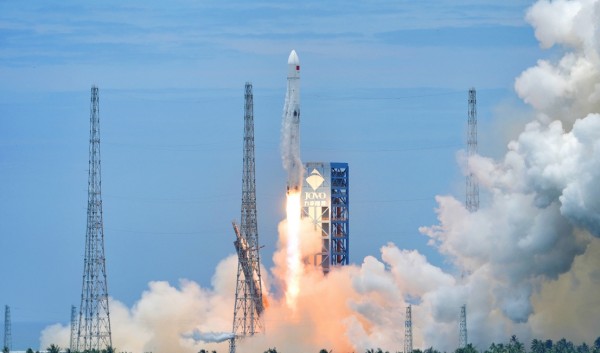
The Long March 10B lifts off on July 10. [Photo/sasac.gov.cn]
The rocket was developed by the China Academy of Launch Vehicle Technology, a subsidiary of China Aerospace Science and Technology Corporation. It consumed liquid propellants for its two stages and the overall lift-off propulsion reached about 890 metric tons.
The 760-ton, 63-meter rocket can put a 16-ton satellite into low-Earth orbit if it is ideally reused. It is capable of carrying out a range of missions, such as deploying a low-orbit satellite constellation and launching large commercial satellites. The rocket’s reusable feature can significantly cut launch costs, making it highly cost-effective.
This lift-off proved the viability of multiple advanced techniques, especially the net-capture recovery on an offshore platform. In the future, engineers will continue to optimize the rocket’s performance and facilitate technical upgrades, aiming for a successful relaunch of the recovered rocket stage by the end of this year.
This mission is the 657th launch of Long March carrier rockets.
(Executive editor: Zuo Shihan)