Typhoon Maysak disrupted power facilities in Qinzhou, Fangchenggang, Nanning and Guigang in South China’s Guangxi Zhuang Autonomous Region.
In response, China Southern Power Grid Co., Ltd. (CSG) adopted various measures to ensure a stable power supply for government emergency command centers, essential users, and residents. CSG’s emergency response teams rushed to Guangxi with emergency equipment, aiming to provide necessary technical assistance.
As of 7 am on July 10, CSG has maintained a Level-2 emergency response to disastrous winds and floods. It has deployed 24,000 workers, 510 power-generating vehicles and 69 drainage trucks in this region.
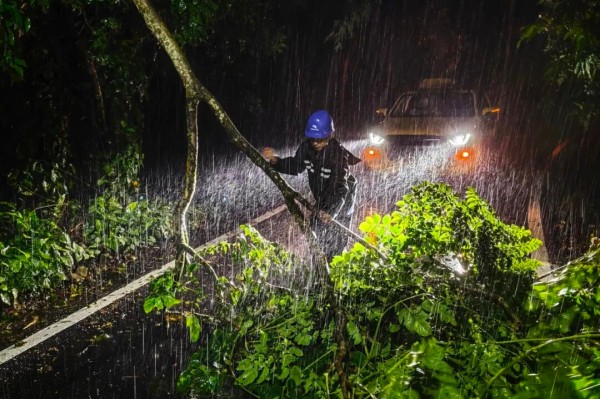
An employee of CSG Fangchenggang Power Supply Bureau in Guangxi Zhuang Autonomous Region clears fallen tree branches while inspecting a faulty power line. [Photo/sasac.gov.cn]
Responding to Disaster in Solidarity
The rainstorm resulted in landslides, flooded roads, and inundated power distribution facilities, forcing repair workers to perform their duties during breaks in the rain.
Access to a 10-kilovolt electricity transmission line in Fangchenggang was blocked by fallen trees. To repair it as quickly as possible, emergency workers had to clear the debris first before getting to the site on foot.
Also in Fangchenggang, repair vehicles of the Nasuo Power Supply Station were unable to reach their destination as the road was cut off by a landslide. Local villagers volunteered to ferry repair workers by motorcycle and clear the debris on the road. With their help, power was restored that very day.
Tech-powered disaster response
CSG adopted a comprehensive digital system in response to disasters in Guangxi by operating more than 7,000 transmission line video monitoring devices around the clock. Drones were deployed to inaccessible areas to assess damages, without exposing workers to unnecessary risks. Tethered lighting drones served as aerial light towers, illuminating repair sites at night and overcoming the challenges posed by darkness and difficult terrain.
Leveraging an integrated command and dispatch platform, grid operators at all levels monitored tripped transmission lines, affected distribution service areas, and the real-time locations of repair crews. In this way, CSG could prioritize power supply to crucial establishments such as hospitals and temporary shelters, while implementing a dedicated power supply plan for reservoirs and areas vulnerable to geological hazards.
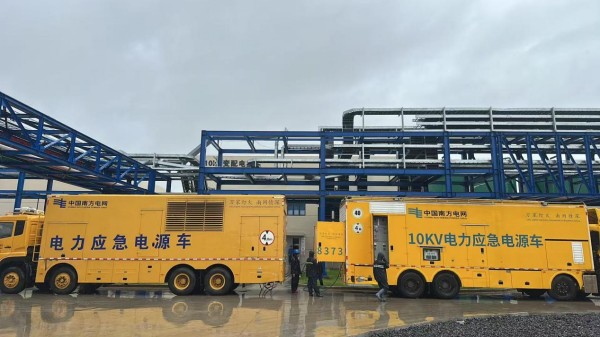
Power-generating vehicles are deployed to a petrochemical enterprise in Qinzhou after a fault occurred on the power supply line. [Photo/sasac.gov.cn]
Assistance to Local Governments
CSG’s local subsidiaries worked closely with government departments and grassroots governance bodies in disaster response, ensuring emergency power supply for temporary shelters. They also sent electricity safety alerts via WeChat groups and text messages during the heavy rainfall.
Repair crew assisted government workers in evacuating residents and inspecting flooded regions, so as to cut off power when floods came and resume it when the water retreated.
In response to the latest power disruptions in the cities of Guigang, Liuzhou and Nanning, additional repair personnel and equipment were deployed dynamically. They worked in designated service zones on round-the-clock shifts, minimizing the time required to restore power to all affected areas.
The emergency response is still ongoing. CSG will continue to monitor the heavy rainfall in Guangxi and do its best to restore power to remaining affected lines and flooded distribution facilities, all in order to ensure a reliable electricity supply for local residents and businesses.
(Executive editor: Zuo Shihan)