As of July 1, the Qinghai-Xizang Railway, which stands at an average altitude of over 4,000 meters, has been fully operational for 20 years.
China Railway Construction Corporation Limited (CRCC) has played a major role in building and continuously operating and maintaining the rail, despite the challenging conditions on the snowy plateau, known as the “Roof of the World”.
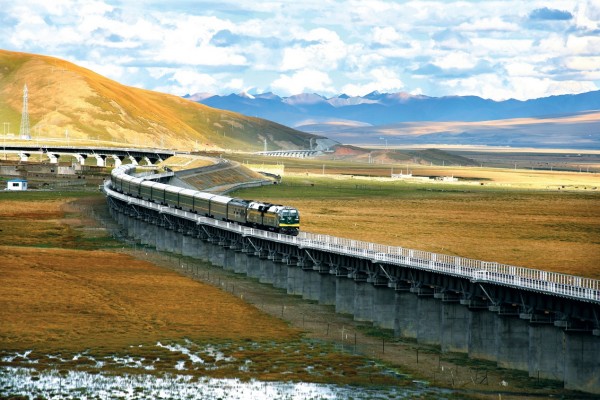
A glimpse of the Qinghai-Xizang Railway. [Photo/sasac.gov.cn]
Challenges and Solutions
In 2001, the construction of the Golmud-Lhasa section of the Qinghai-Xizang Railway began, with engineers facing an unprecedented combination of obstacles: permafrost, extreme altitude with low oxygen levels, and a fragile ecosystem. The CRCC was responsible for the entire railway’s engineering design and 72 percent of the construction work, including all construction at elevations above 4,900 meters.
The Fenghuoshan Tunnel, as a crucial part of the Golmud-Lhasa section, is located at an altitude of 4,905 meters in Yushu Tibetan Autonomous Prefecture in Qinghai Province. The thin air and frozen soil were two significant construction challenges.
The CRCC engineers built the world’s highest-altitude oxygen supply station, providing continuous oxygen throughout the tunnel to improve working conditions for construction crews. The team also pioneered an "active cooling" approach to permafrost engineering. As a result, the Fenghuoshan Tunnel was completed in just 13 months.
CRCC engineers also successfully poured concrete for the Sancha River Grand Bridge in temperatures as low as -30°C, and extended the railway to an altitude of 5,072 meters at the Tanggula Pass, setting a world record.
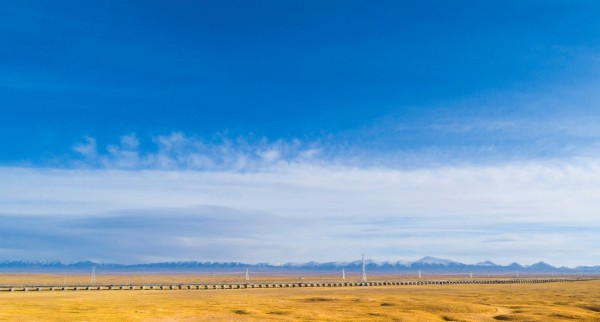
The Qingshui River Grand Bridge is located in Hoh Xil, a national nature reserve known as an important habitat for Tibetan antelopes. [Photo/sasac.gov.cn]
Another notable example is the Qingshui River Grand Bridge in Hoh Xil, a national nature reserve known as an important habitat for Tibetan antelopes. This 11.7-km bridge leaves more than 1,300 openings for the passage of wild animals, achieving a harmony between human transportation and animal migration.
Through the construction of the Qinghai-Xizang Railway, CRCC has achieved a series of major technological breakthroughs, developing a fully integrated suite of proprietary technologies for railway construction across high-altitude permafrost, creating a dozen world records, including the world's highest railway, the longest plateau railway, and the fastest railway operating at high altitude.
Continuous Improvements
The Qinghai-Xizang Railway has been continuously extended and upgraded since it started operations. In 2014, the railway stretched from Lhasa to Shigatse, with the route designed and built by CRCC. In 2021, the Lhasa-Nyingchi Railway entered service, allowing Xizang full access to bullet trains. With these additions, the Qinghai-Xizang Railway evolved from a single trunk line into a Y-shaped rail network centered on Lhasa.
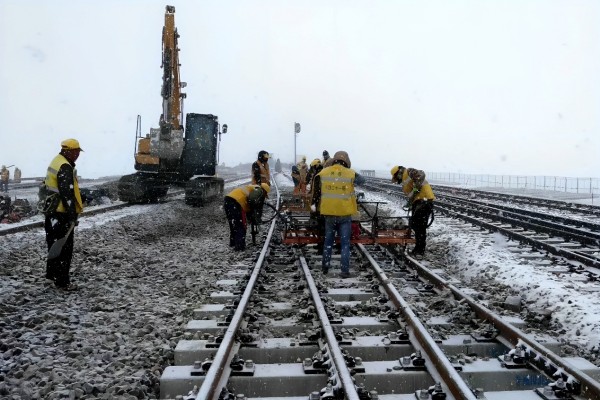
Upgrading of the Golmud-Lhasa section is underway. [Photo/sasac.gov.cn]
As the transport capacity of the Golmud-Lhasa section couldn’t meet the increasing transportation needs, the CRCC upgraded the section in 2018 by adding 13 stations and reduced freight train travel time by two hours, enhancing the section’s transport capacity by 80 percent. In 2023, the corporation improved all 56 stations along the railway and replaced 126 sets of switches with domestically made systems, significantly enhancing the safety of train operations.
CRCC also emphasized maintenance. Its subsidiaries organized workers to regularly inspect and repair tracks, and one of the maintenance workshops was installed in Amdo County of Xizang, which protected 146 km of the rail at an altitude of 4,702 meters.
Environmental Protection
The Qinghai-Xizang Plateau is one of the world's most ecologically fragile regions. The CRCC has steadfastly prioritized environmental protection from the very beginning when it initiated pre-construction surveys. In collaboration with an authorized institution, it compiled six comprehensive environmental protection guidelines and pioneered both independent third-party environmental supervision for railway construction and dynamic ecological monitoring.
To protect permafrost, the construction team built ventilated foundations and opted for bridges when necessary in order to lower the temperature of the underlying permafrost and solidify the foundation. Excavated tunnel spoil was transported to abandoned roadbeds to avoid any new damage to the meadows. Gulu Station exemplified a bold attempt at environmental protection by creating an 80,000-square-meter artificial wetland. In the summer of 2002, the railway construction was halted for 15 days, allowing Tibetan antelopes to migrate to the Zhuonai Lake in Hoh Xil for calving. Now, 33 dedicated wildlife crossings have been established along the line, creating safe corridors for Tibetan antelopes and other wildlife.
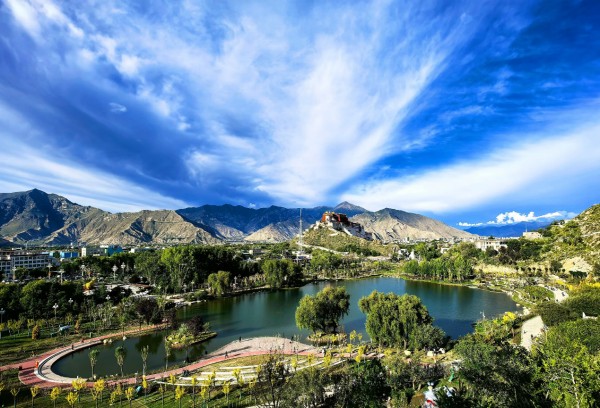
This photo shows the Yaowang Mountain after environmental restoration. [Photo/sasac.gov.cn]
Over the past two decades, CRCC has shifted its construction strategy from minimizing environmental impacts to actively restoring ecosystems. The corporation has made efforts to transform once desolate spaces, such as Yaowang Mountain in Lhasa, into vibrant green areas.
Rural Vitalization on the Plateau
The Qinghai-Xizang Railway has benefited the local populace as it has greatly promoted economic and social development in the two provincial-level regions. CRCC has been deeply engaged in this process. By the end of 2025, it had undertaken over 250 projects related to highways, railways, residential construction, water conservancy, new energy, ecological protection and digital industries.
During the 14th Five-Year Plan (2021-25) period, the Qinghai-Xizang, Lhasa-Shigatse and Lhasa-Nyingchi railways have delivered over 25 million passenger trips and over 40 million metric tons of goods to and from Xizang, effectively meeting people’s needs. In 2024, an expressway connecting Lhasa and Shigatse opened to traffic, along which CRCC constructed dozens of bridges and tunnels, reducing the inter-city travel time to less than 3 hours.
Regarding education in Xizang, CRCC has built a wide range of educational facilities, expanding access to quality education for students across the region. The company has also funded the construction of 28 rural kindergartens in Shigatse.
By tapping into natural spring resources in Chamdo City, CRCC has developed a model that combines production, processing and sales with agriculture, culture, and tourism, creating new pathways for sustainable development and rural vitalization in Xizang.
Over the past 20 years, CRCC has expanded its support from providing assistance to building long-term self-sustaining development capacity, ranging from railway infrastructure construction to comprehensive support for industry, education, and talent development. The corporation, with its great industrial advantages and corporate social responsibilities, has built a railway to the plateau and supported its transformation from a single "Sky Road" to an integrated rail network.
(Executive editor: Zuo Shihan)