At 7:46 am on July 2, a Long March 4B carrier rocket lifted off from the Jiuquan Satellite Launch Center in Northwest China to put an HY-2E oceanographic research satellite into a preset orbit.
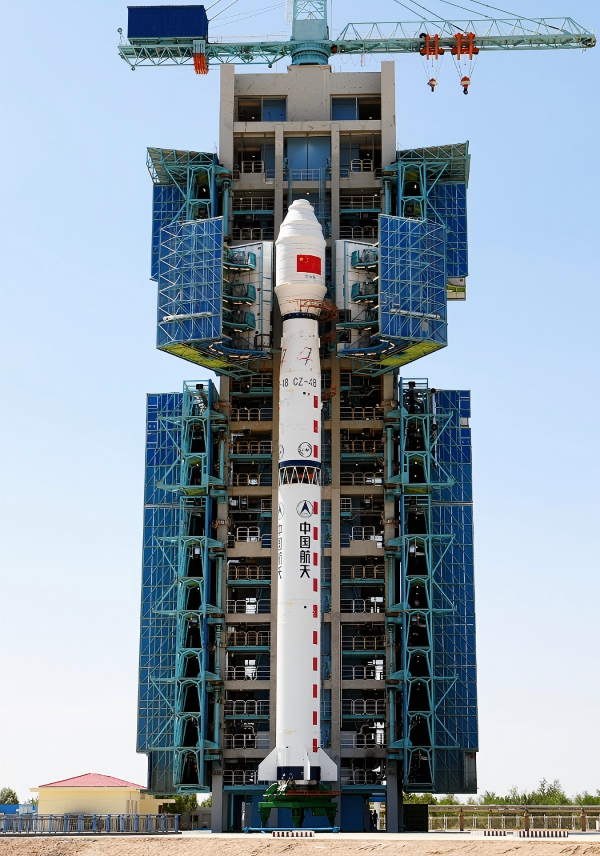
The Long March 4B carrier rocket is ready for launch. [Photo/sasac.gov.cn]
The HY-2E satellite was developed by the China Academy of Space Technology, a subsidiary of China Aerospace Science and Technology Corporation (CASC). It is designed to be as highly efficient and comprehensively capable as its peers of the HY-2 series and is equipped with upgraded technologies that can enhance its observation of nearshore marine areas. It can play a significant role in marine protection, disaster prevention and relief, marine resource utilization and oceanographic research.
The HY-2E satellite will replace the HY-2B satellite launched in 2018 to collaborate with the HY-2C and HY-2D satellites as an entire network, ensuring continuous and stable oceanographic monitoring of China’s seas.
The Long March 4B carrier rocket was developed by the Shanghai Academy of Spaceflight Technology, another CASC subsidiary. It is a three-stage rocket fueled by a normal-temperature liquid propellant, capable of placing a variety of satellites into orbit and lifting one or multiple satellites onto their preset orbits in a single mission, as long as their weights are within the rocket’s payload — 2.5 metric tons for the 700-kilometer sun-synchronous orbit.
As the launch day was hot and dry with strong, dust-raising winds, engineers made extensive calculations and engaged in rounds of experiments in cooperation with the launch site system, improving preventive measures to ensure a successful lift-off in such adverse conditions.
The launch marked the 654th mission for the Long March carrier rockets.
(Executive editor: Zuo Shihan)