The first unit of the Shuangjiangkou Hydropower Station was connected to the grid on June 26 in Aba Tibetan and Qiang Autonomous Prefecture in Southwest China’s Sichuan Province.
The hydropower station, built by China Energy Investment Corporation Co., Ltd. (CHN Energy), has the world’s tallest dam of 315 meters. It will substantially contribute to the establishment of Southwest China’s clean energy supply system and China’s pledge to achieve carbon peaking and carbon neutrality goals.
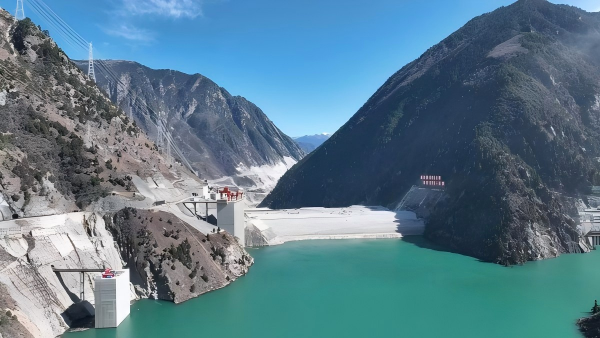
The rockfill dam stands 315 meters tall, requiring more than 46 million cubic meters of fill material during construction. [Photo/sasac.gov.cn]
The Shuangjiangkou Hydropower Station, one of China’s key energy projects, serves as both a leading power station and a control reservoir on the upper reaches of the Dadu River, a secondary tributary of the Yangtze River. The project is designed primarily for power generation while also providing flood control benefits.
With a total installed capacity of 2 GW, the hydropower station can generate 7.7 TWh annually. It has completed the second phase of reservoir impoundment, ready for full power generation. The project is operating safely, stably, and under full control.
As a reservoir, it is capable of annual flow regulation and has a total water storage capacity of 2.9 billion cubic meters. Once fully operational, it is expected to increase the annual power generation of the cascade power station cluster downstream by 6.6 TWh. The project will also strengthen the peak-shaving and frequency regulation capabilities of the Sichuan power grid, optimize the region's power generation mix, and substantially improve flood prevention and control capacity across the Dadu River Basin. It will serve as a vital flood control safeguard for the upper reaches of the Yangtze River.
With the operation of the Shuangjiangkou Hydropower Station, CHN Energy now has 15 GW of hydropower and renewable energy capacity in operation in the Dadu River Basin. These facilities supply more than 60 TWh of clean energy annually, equivalent to saving approximately 17 million metric tons of coal and reducing carbon dioxide emissions by about 46 million tons each year. They strongly support the regional economic development and eco-environment protection in Sichuan and its neighboring Chongqing Municipality.
(Executive editor: Zuo Shihan)