The Tianwan Tidal Flat Photovoltaic Power Station lies off the Yellow Sea coast of Lianyungang City in East China’s Jiangsu Province. Covering 28,000 mu (18.67 square kilometers), the power station constructed by China National Nuclear Corporation stands as the largest offshore photovoltaic project in China.
Recently, two underwater robots were ready to engage in a trial of automatic inspection of this power station, after they completed strict testing in freshwater surroundings.
The Tianwan Tidal Flat Photovoltaic Power Station is supported by over 60,000 prestressed, concrete tubular piles underwater. To ensure the safety of the entire structure, the two robots will conduct an all-around, precise and intelligent inspection, saving human labor.
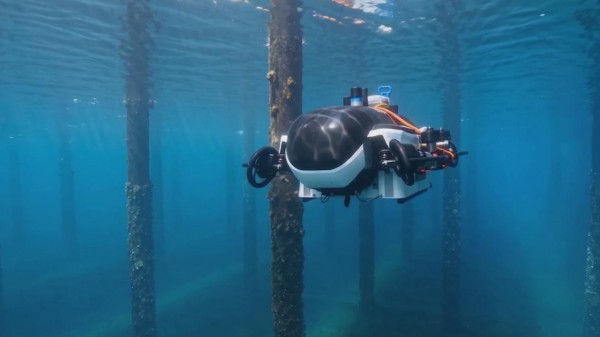
A robot of the “underwater medical team” inspects the Tianwan Tidal Flat Photovoltaic Power Station, which boasts an installed capacity of 2 million kilowatts. [Photo/sasac.gov.cn]
Why Robots
Saltwater corrosion and corrosion from other elements can weaken the structure of underwater photovoltaic piles, making inspection essential. However, conventional manual inspection is often risky, inefficient, and sometimes impossible in remote or deep-sea locations. So a more intelligent plan must be adopted.
The project team decided to develop a robot capable of automatically completing underwater missions, so as to extend the service life of piles and ensure a stable power supply.
“By equipping it with a camera and sonar, the underwater robot can approach the piles and carefully scan them,” said Cui Jinjun, head of the technical team for robotics. “It must also have an artificial ‘brain’, so that it can analyze images and automatically identify issues, such as corrosion, cracks and biological attachments, with an accuracy of no less than 95 percent.”
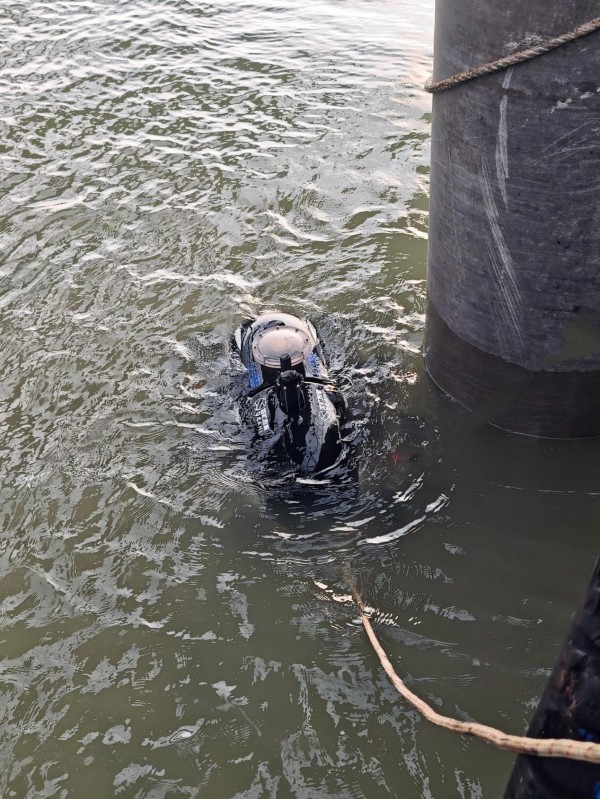
A robot is engaged in an “eyesight” test at sea. [Photo/sasac.gov.cn]
Charge and March
While the concept was promising, the path to realization was fraught with challenges. One of the biggest hurdles was how to give the robot a long lifespan.
To charge conventional underwater robots, technical personnel have to either connect them with cables or frequently scoop them up — it sounded like a hard choice between limited activity space and low work efficiency. The technical team, however, turned to cutting-edge underwater wireless charging technology.
Underwater robots usually have to precisely plug themselves into a charging pile. This method of charging them is costly, technically complicated and fraught with shortcomings, such as fragility from corrosion.
To address these issues, the technical team employed the technology of magnetically coupled resonant wireless power transmission to enable autonomous, convenient power delivery to an underwater robot, allowing it to continuously operate in the waters. They developed a new wireless charging system that can maintain over 90 percent of transmission efficiency underwater, enhancing robot performance efficiency.
After the technical team perfectly addressed the endurance issue, they began exploring another issue — how the robots identify their underwater locations and precisely reach every pile for check. They made a large amount of improvements on high-precision underwater location and automatic guidance systems in light of robot’s performances, such as static hovering, S-shaped turning and pile-centered pivoting.
The robot maneuvered more and more precisely, with the deviation minimized to merely two meters when it moved 1,000 meters.

What the “eye” of an underwater robot sees. [Photo/sasac.gov.cn]
Testing speaks louder than design. At a calm water test basin in Changshu, a county-level city in Suzhou City, Jiangsu Province, the underwater robots underwent a test that lasted for months.
The rigorous testing had eight crucial facets, including precise identification, automatic docking and return, wireless charging, dual-robot collaboration and an all-around practice.
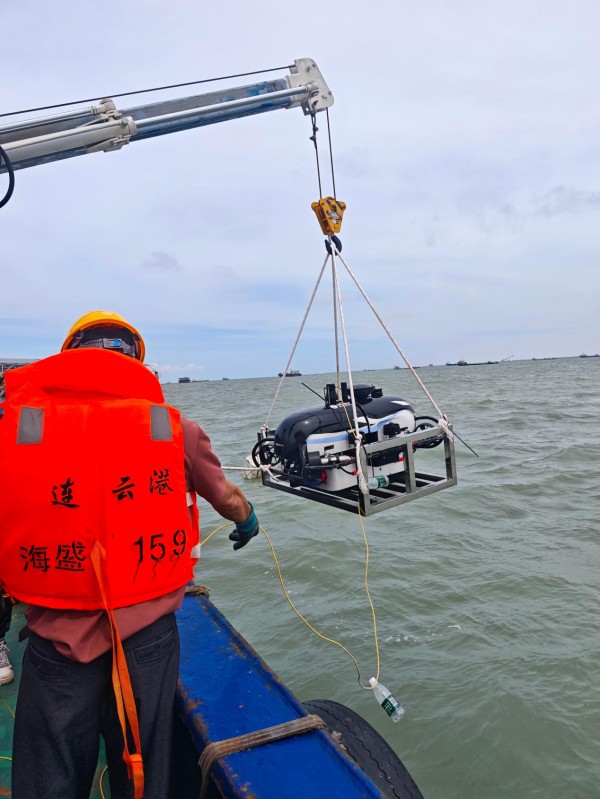
A robot adapts to marine conditions before it executes commands. [Photo/sasac.gov.cn]
But the robots faced multiple challenges. They were pushed out of place by waves and failed to align with the catcher. They vied to connect with the same charging pile, which weakened their cooperation. The efficiency of the charging pile was also reduced, because some components loosened during their transport.
The technical team worked out solutions. They divided the process of docking and return into four minor steps, and, depending on that, they optimized the parameters in each step. They applied a smart distribution system for the two robots, so that the one with less electricity or executing a more prioritized mission could become the first for charging. They also glued all the necessary screws of the charging pile to avoid any potential untightening mishaps.
After continuous improvement, the robots could ultimately complete their tasks stably. They could be anchored with the catcher over 90 percent of the time and could finish their long-term work without any confrontation with their counterpart.
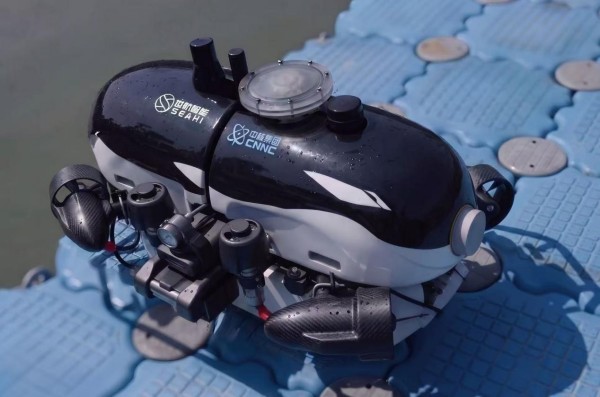
The underwater inspector is now automatically operational. [Photo/sasac.gov.cn]
Here They Go for a Real Job
After the test in Changshu, the robots were well prepared and qualified to operate at sea near Lianyungang, their real workplace.
Tides, waves and wind often visit Tianwan Tidal Flat Photovoltaic Power Station. These factors are a harsh test for this “underwater medical team”, which has to prove its capabilities of regularly and automatically inspecting the power station’s piles.
More than a technical try, the robots also represent an intelligent method for the maintenance of offshore set-ups, which is worth being promoted in the future.
(Executive editor: Zuo Shihan)