The recent trial of an electric towboat’s power transmission to the grid at Lianyungang Port in East China’s Jiangsu Province has been lauded as the country’s first power transmission from a vessel to a micro grid.
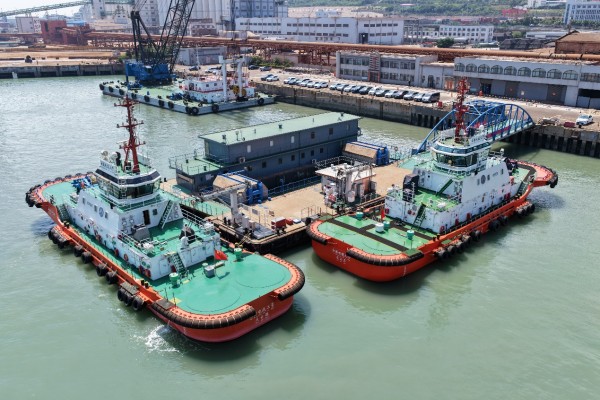
A panorama of how the towboat delivers electricity back to the port grid. [Photo/sasac.gov.cn]
The electric towboat, christened Yugang Electric Towboat No. 9, was connected to the micro grid via shore cables. Unlike the regular transmission from grid to ship, the towboat completed a reverse process — it released electricity from its storage system to the micro grid securely and stably. The whole process lasted seven hours, transmitting 560 kilowatt-hours of electricity and ensuring the efficient performance of quayside container cranes.
Stable power charge and release had remained a challenge in marine circumstances because of the high humidity and salinity, but this pioneering experiment overcame it. Through a ship-grid interaction and coordination device based on a grid-forming control algorithm, the towboat could smoothly switch between power charge and release while docking.
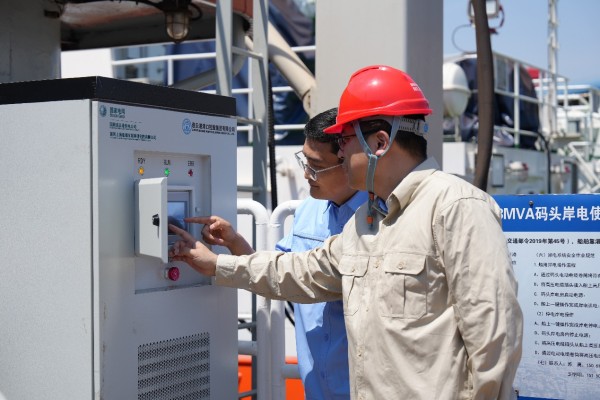
Workers examine a device for the vessel-grid power transmission. [Photo/sasac.gov.cn]
“An electric vehicle can transmit 7 to 15 kilowatts of power to the grid, while a vessel’s capacity in that regard is much larger,” said a department manager of State Grid Corporation of China’s local subsidiary in Lianyungang, the city where the port lies.
Four electric towboats are currently in service for Lianyungang Port. They sail as a mobile energy storage cluster with a capacity of 20,000 kWh, equal to a small energy storage station. Such an amount of power is sufficient for simultaneously operating five large quayside cranes.
“With favorable policies, electric towboats are permitted to be charged and store electricity during off-peak periods and to discharge it to the grid when the peak hours come. This not only reduces the port’s energy costs but also enhances the resilience of the grid, maximizing economic and environmental benefits,” said a port shipment manager.
The trial enriches the role of the vessel — it can store power, which provides an example for green shipping transformation and expands the new electric system in China onto the waters.
(Executive editor: Zuo Shihan)