With the installation of the last beam on June 12, the steel-concrete composite girder of the bridge over the Daxi River in Southwest China’s Chongqing was precisely positioned, marking the completion of the main steel structural works of the bridge.
The steel-arch bridge has the world’s longest span of its type and is a crucial part of the expressway connecting Wulong District and the Liangjiang New Area in the city.
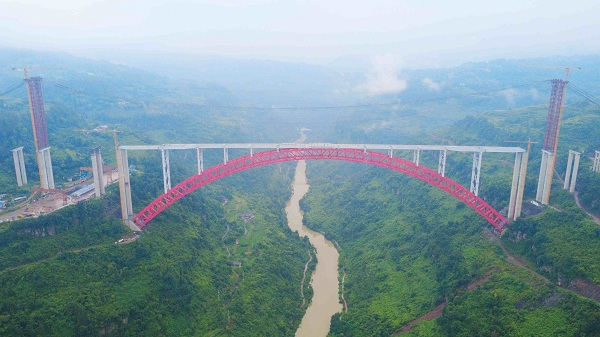
The steel-concrete composite girders of the Daxi River Bridge are joined together. [Photo/sasac.gov.cn]
The bridge spans the Daxi River gorge in Wulong District. It is 1,136.7 meters long, with the longest distance between the bridge deck and the river below surpassing 310 meters, equal to the height of a 100-story structure. The bridge features an all-steel structural design and its total steel usage adds up to about 25,800 metric tons.
The complex terrain, turbulent airflows, and significant temperature fluctuations between day and night at the construction site, as well as the use of an ultra-long cantilever erection method, pose great challenges to the construction team. They introduced systematic innovations in girder arrangement, bearing systems and structural segmentation to strengthen the bridge’s overall structural safety.
The team employed multi-angle rotating lifting equipment to achieve the precise positioning and rotation of the composite girders within a limited space. They set up an intelligent, comprehensive and dynamic monitoring system to track stress and linear changes in the steel structure around the clock. Through repeated adjustments and meticulous operations, they finally ensured high-precision alignment of the girders.
The Wulong-Liangjiang expressway spans 37.18 kilometers. Once open to traffic, it will not only effectively facilitate travel to the top tourism attractions along the route, such as Xiannv Mountain and Baima Mountain, but also smooth the industrial collaboration and resource allocation in the southeastern area of Chongqing.
(Executive editor: Zuo Shihan)