Three years ago, Yenge Village was an isolated piece of land located on the red, muddy terrain of Lualaba Province of the Democratic Republic of the Congo in Africa.
When the rainy season came, dirt roads turned into ankle-deep mud and travel by any sort of vehicle simply became impossible.
Villagers had to trek for over two hours, carrying locally produced cassava, to exchange it for a few small bags of salt in the nearby town.
During that time, when some elderly folks were stricken by illness, the wild herbs near their homes became their only source of treatment. Children often waded through muddy water to go to school, with their textbooks soaked by rain.
“Good days are far away from us, unless we have a decent road,” a villager said at the time.
Nowadays, however, a gleaming new asphalt road — 6.5 meters wide and 6.67 kilometers long — connects the village to a school, a hospital, and a market. It looks like a glossy black ribbon winding through the landscape.
Bulldozers and excavators are now humming as they work among the new brick houses of residents. Within the village, a medical center, an agricultural market and greenhouses are gradually taking shape.
“In the past, the whole village became a large mud pit during the rainy season,” said the village chief.
“But now the new road reaches every doorstep of our villagers and extends all the way to the market outside,” he added proudly.
“When our Chinese friends came here to do a survey, I followed them every day. I watched how this road was built,” he said.
The transformation came about from a Chinese initiative called the “100 Companies in 1,000 Villages” — a corporate social responsibility project for public benefits under the framework of poverty reduction and rural development as part of the nine China-Africa cooperation programs.
Encouraged by the initiative, La Sino-Congolaise Des Mines S.A., a subsidiary of China Railway Group Limited (CREC), invested $14.4 million to build Yenge Village, turning it into the first new model of its kind in the DR Congo.
By the end of May this year, the construction of various infrastructure has mostly been completed. Corn and cassava crops have been planted across wide, lush farmland and a modern rural area with comprehensive residential functions has emerged.
Locals have become infused with renewed vitality. Due to the huge construction needs, the young people have been able to find jobs that range from laborers to technicians.
“I can earn $20 each day — far more than I was earning outside the village,” said a young brick carrier, who currently works on a medical center construction site.
“More importantly, I can make a better life with my own hands. When the medical center opens, my kids can get vaccinated here. No more distant travel for them,” he added.
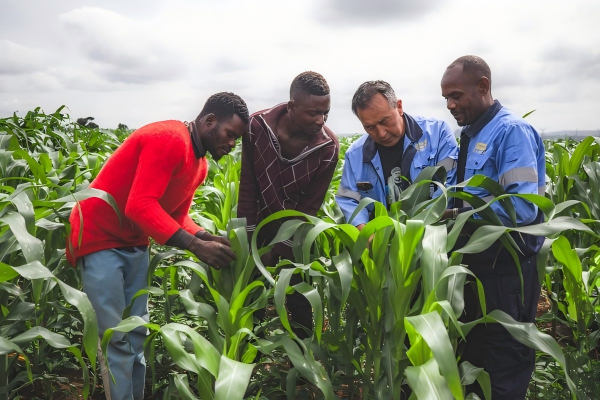
A Chinese expert provides local farmers with modern agricultural know-how. [Photo/sasac.gov.cn]
Another example of progress is a 25-year-old technician, who has mastered the skill of measuring the foundations of buildings using a spirit level.
“I once did a part-time job in the town, with a poor income. But my Chinese tutor taught me to read drawings and use instruments. Now I have become a technician,” he enthused.
The Chinese company has also built a primary school for local people.
“In the past, there was an outdoor classroom for kids under the trees, which had to stop when it rained. But now look at this beautiful classroom — it has glass windows, a blackboard and a sturdy roof,” said a teacher standing in front of the classroom of the newly built Dikuluwe Primary School.
“Our Chinese friends even asked us what color we wanted to paint the walls. They said, ‘This is your school and it should be to your liking,’” he added.
The metamorphosis of the village is a vivid example of how the China-Africa cooperation blueprint has been translated into tangible assets.
“We bring here more than money and technology,” said an executive from the Chinese company. “We also bring China’s development experience, helping locals to build their future with their own hands.”
In the wake of the “100 Companies in 1,000 Villages” program which is now taking root in Africa’s soil, the metamorphosis of underdeveloped villages is no longer a dream, but has become an unfolding reality.
(Executive editor: Zuo Shihan)