The construction of China’s largest solar-hydrogen-storage integrated project was fully completed on June 10 in Rudong, a county in East China’s Jiangsu Province.
The project, developed by Guohua Energy Investment Co., Ltd., a subsidiary of China Energy Investment Corporation Co., Ltd., inaugurates a new energy collaborative operation model that deeply integrates power sources, the transmission grid, loads, and energy storage systems with hydrogen energy.
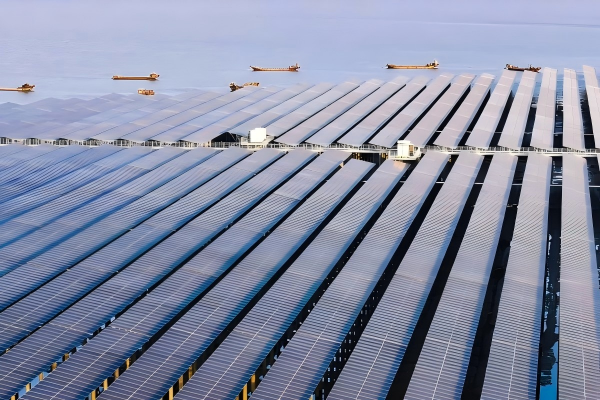
China’s largest solar-hydrogen-storage integrated project is fully completed on June 10, 2026, in Rudong, a county in South China’s Jiangsu Province. [Photo/sasac.gov.cn]
The project, located at Yangkou Port, has a total photovoltaic capacity of 400,000 kilowatts, with a newly built 220-kilovolt onshore step-up substation, an electrochemical energy storage station, and a hydrogen production station able to produce 1,500 standard cubic meters per hour. Together, these facilities establish a complete industrial chain encompassing green electricity generation, storage, and conversion.
The photovoltaic plant is expected to generate 468 million kilowatt-hours of electricity annually, enough to meet the power demands of nearly 200,000 households while offsetting over 300,000 metric tons of carbon dioxide emissions. The collocated power storage facility effectively smooths grid fluctuations and enhances renewable energy accommodation.
In addition, the project can also produce 482 metric tons of high-purity green hydrogen annually, achieving a zero-carbon production process. The hydrogen is designated for supply across the Yangtze River Delta, supported by synchronously commissioned hydrogen refueling stations, thus completing the full value chain for green hydrogen application.
(Executive editor: Zuo Shihan)