At 2:18 pm on June 4, the installation of the world’s largest offshore converter station, the Heart of the Sea Wind, was completed off the coast of Yangjiang City in South China’s Guangdong Province.
The whole installation took almost seven hours, with Xiang Tai Kou, a semi-submersible heavy lift vessel, precisely aligning the converter station with the jacket foundation.
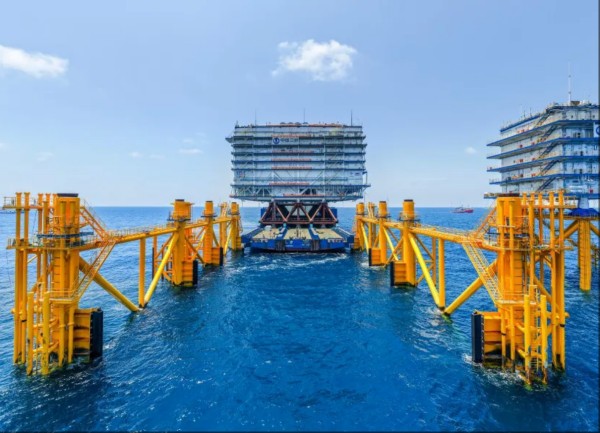
The Heart of the Sea Wind converter station is prepared for installation on the jacket foundation with the help of Xiang Tai Kou, a semi-submersible heavy lift vessel. [Photo/sasac.gov.cn]
The converter station consists of two parts — the upper 7-storey steel-structure and its lower jacket foundation. The steel construction was 85.5 meters long, 82.5 meters wide and 44 meters tall, weighing about 25,000 metric tons. The jacket foundation was 82 meters long, 57 meters wide and 69 meters tall, weighing about 17,000 tons. Eight piles of the jacket foundation could hold the upper construction very stably.
The substantial weight of the converter station far exceeded the hoisting capacity of any domestic ships, so the installation team had to figure out a creative means of completing the task.
They came up with the idea of “float-over installation”. Like a car reversing into a parking spot, the steel-structure could be slowly moved into place with the help of tides and the dynamic positioning system of the heavy lift vessel. Both edges of the upper construction were only 150 millimeters away from the jacket foundation. Rubber fenders and coupling devices on pile legs were used to mitigate possible collisions between the construction and the jacket foundation, so as to precisely complete the installation.
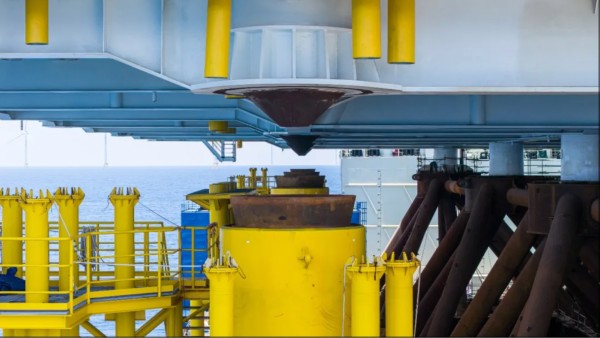
The tips of the upper steel-structure construction are coupled with the legs of the lower jacket foundation. [Photo/sasac.gov.cn]
The converter station was more than 70 kilometers offshore, while conventionally such facilities are close to the shore. Strong winds, waves and currents, corrosive salt, fog and frequent typhoons all posed significant challenges to the installation.
To ensure environmental factors, such as wind speed, were conducive to the float-over installation, the team verified the data provided by multiple weather forecasters and ultimately chose sometime after 7:00 am on June 4 as the start time — and then they made a successful installation.
The Heart of the Sea Wind converter station has the world’s highest voltage and largest transmission volume of offshore wind power, flexible DC transmission projects. Upon operation, it will deliver approximately 6 billion kilowatt-hours of clean electricity annually to the Guangdong-Hong Kong-Macao Greater Bay Area, reducing carbon dioxide emissions by nearly 5 million tons.
(Executive editor: Zuo Shihan)