China’s first X-band Synthetic Aperture Radar (SAR) satellite that is specialized for energy engineering, the Dianjian-1, transferred the first batch of high-precision images of dams, reservoirs and transmission lines back to Earth on May 22.
The delivery of the images took place only one week after the satellite’s launch on May 15. They were taken only 48 hours after the satellite had entered its preset Sun-synchronous orbit, 500 kilometers above the Earth’s surface.
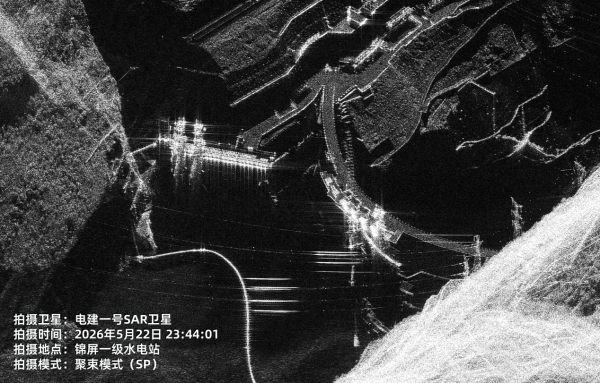
One of the images shows a hydropower station in Southwest China’s Sichuan Province. [Photo/sasac.gov.cn]
Decision to Reach for the Sky
The satellite was produced by POWERCHINA Chengdu Engineering Corporation Limited (POWERCHINA Chengdu), a subsidiary institute of Power Construction Corporation of China (POWERCHINA).
For a research institute that specializes in energy infrastructure, it initially seemed an unrealistic dream to develop such a satellite.
Since its establishment in 1950, the institute has conducted water resource surveys across more than 200 rivers in China, half of the country’s water energy sources.
The installed capacity of hydropower stations that it had surveyed or designed accounts for a quarter of China’s total installed hydropower capacity. After much deliberation, it was decided that building a satellite was something the institute could and should do.
The fundamental rationale for developing the satellite was that drones and lasers were far from capable of conducting safety monitoring on China’s large energy projects, often located amid complex and remote geological sites such as deeply buried tunnels and steep, unstable slopes.
More importantly, the crucial data could only be provided by foreign commercial radar satellites, at a high cost yet with a significant time delay, not to mention the lack of access to their core processing algorithms. All these considerations prompted the institute to go ahead with its very own satellite project.
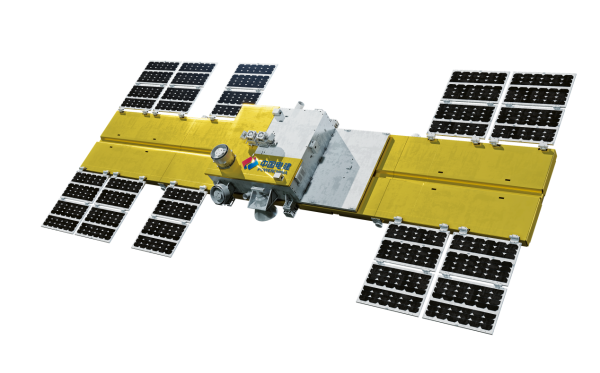
An overview of the Dianjian-1. [Photo/sasac.gov.cn]
At the beginning, the institute studied the technical details of Germany’s TerraSAR-X and Italy’s COSMO-SkyMed, but soon realized that those celestial eyes were not compatible with engineering monitoring needs.
These all-purpose SAR satellites merely emphasized the need for ultra-high definition pictures. What the institute needed was a satellite that could precisely revisit every place on its orbit and be ultra stable in shooting images — ensuring monitoring of changes at the millimeter level. As a result, it was determined that innovation was the only way to address the pressing issue.
Design Based on Existing Needs
POWERCHINA formed a team of diverse expertise backgrounds and collaborated with other institutes, including the China University of Geosciences, to create a customized satellite that meets all the existing needs.
The engineering team started from those needs and an X-band SAR satellite was finally developed after much effort, weighing about 300 kilograms, a quarter of the TerraSAR-X’s weight.
The satellite featured an integrated mechanical, electrical and thermal system design, thereby lowering the launch cost. In particular, its orbital path fluctuated within a range of only 200 meters, achieving a major leap in interferometric measurement stability.
The satellite employs a flat-panel X-band phased-array radar system, whose resolution is better than 0.5 meters in spotlight mode. Leveraging InSAR technology, the satellite can conduct all-weather, around-the-clock monitoring of millimeter-scale deformation in the Earth’s surface and engineered structures.
With these capabilities, the satellite is able to provide early warnings about changes in conditions on the Earth’s surface.
Take Control of the Data
The launch of Dianjian-1 on May 15, from the Dongfeng commercial space innovation pilot zone in Northwest China, meant that from now on China can independently monitor the safety of its major energy projects and no longer has to rely on satellites of other countries.
The satellite has facilitated the establishment of a fully independent X-band radar satellite technology chain, covering everything from satellite operations to data processing and application services.
The ground receiving station transfers satellite data to a data processing center, where the data is then instantaneously analyzed via high-performance software to produce the necessary engineering information. The whole data transmission and analysis process is totally independent, safe and controllable.
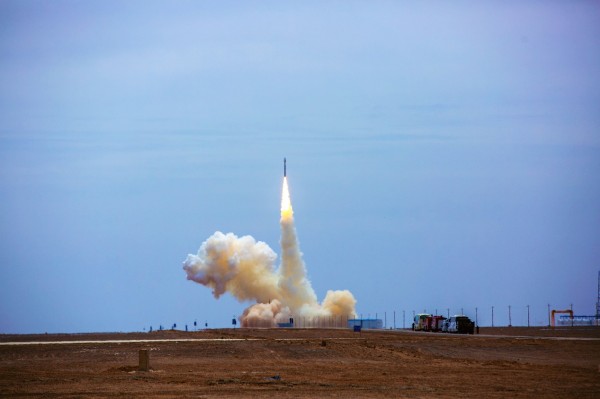
The Dianjian-1 is launched from the Dongfeng commercial space innovation pilot zone in Northwest China on May 15. [Photo/sasac.gov.cn]
The Dianjian-2 — a low-Earth-orbit microwave rainfall measurement satellite initiated at the same time as Dianjian-1 — is currently being developed. In the future, the series of satellites will form a space-based information support system that covers the entire lifecycle of energy projects from survey, design, construction to operations.
A vision of an integrated space-air-ground-subsurface-underwater intelligent sensing network is gradually taking shape. Satellites will conduct monitoring from space, drones will perform low-altitude inspections, sensors will be deployed on the surface and underground, while monitoring equipment is installed underwater.
Journey Just Begins
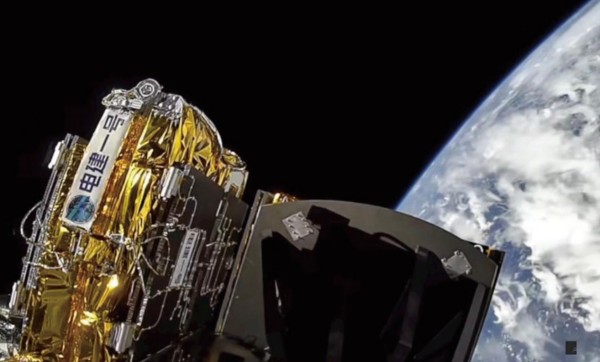
An image of the Dianjian-1, now in position above the Earth. [Photo/sasac.gov.cn]
After entering orbit, Dianjian-1 can perform a wide range of roles. It can detect subtle signs of ground deformation across large areas via time-series InSAR technology, so as to give a proactive warning on geological disaster risks, such as landslides and slope collapses.
The satellite can conduct non-contact, continuous monitoring of structural deformation at major infrastructure assets — including dams, tunnels and bridges — identifying changes and ensuring precise, preventive responses.
The satellite will continuously accumulate data on spatiotemporal deformation, allowing the institute’s personnel to optimize their designs and enable long-term project operations and maintenance.
With its low cost, high precision and high frequency capabilities, Dianjian-1 is indisputably the safest solution being offered by POWERCHINA to monitor infrastructures in complex circumstances, operating in extreme climates and facing risks of dangerous geological disasters.
After the first batch of images was transmitted to Earth, the project team members carefully observed each structure shown on the screen. These giant power infrastructure projects, built over decades in the mountains, are now being closely watched by a small 300-kg satellite that is some 500 km away in space.
Over the past 70 years, POWERCHINA Chengdu has built hydropower stations and launched a satellite into space. The journey of Dianjian-1 has just begun. From now on, it will orbit the Earth once every 90 minutes and monitor the country’s mega-projects scattered across mountains, valleys, and some of the world’s most challenging terrain.
A new monitoring paradigm combining satellite observation from space, ground-based verification, and integrated data analysis is taking shape. The small satellite is now traveling along its sun-synchronous orbit, serving as a steadfast guardian of China’s energy infrastructure.
(Executive editor: Zuo Shihan)