The Long March 12B carrier rocket lifted off from the Dongfeng commercial space innovation pilot zone in the Inner Mongolia Autonomous Region at 4:40 pm on June 1.
After a short flight, it placed the 10th group of Spacesail Constellation communication satellites into its preset orbit, marking a complete success on its inaugural mission. With high payload capacity, the Long March 12B adds a new heavy-lift commercial launch option for China’s large-scale low-Earth-orbit internet constellation deployments.

The Long March 12B carrier rocket lifts off from the Dongfeng commercial space innovation pilot zone in the Inner Mongolia Autonomous Region at 4:40 pm on June 1. [Photo/sasac.gov.cn]
Designed and built by China Aerospace Science and Technology Commercial Launch Vehicle Group, a subsidiary of China Aerospace Science and Technology Corporation (CASC), the Long March 12B carrier rocket is tailored for commercial missions.
The new-generation 4-meter-class partially reusable two-stage launch vehicle features a single-core two-stage configuration, with a body diameter of 4.37 meters, a 5.2-meter fairing, and a total length of about 72 meters. The first stage is powered by 9 YF-102R engines and the second by a YF-102RV engine, which are all fed by liquid oxygen and kerosene. It has a low Earth orbit payload capacity of about 20 metric tons, and is capable of performing multi-orbit missions.
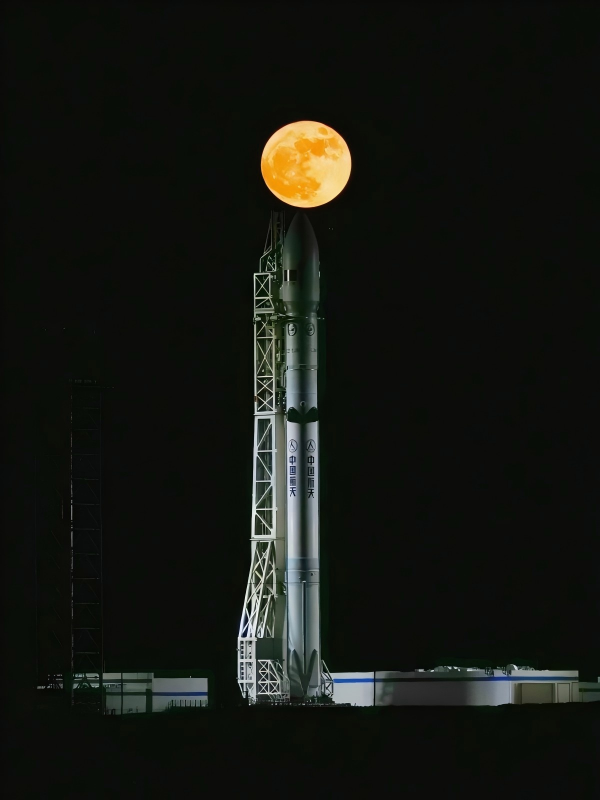
The Long March 12B carrier rocket is developed by China Aerospace Science and Technology Commercial Launch Vehicle Group, a subsidiary of China Aerospace Science and Technology Corporation (CASC). [Photo/sasac.gov.cn]
The launch pad used for this mission was designed and built by China Aerospace Science and Technology Commercial Launch Vehicle Group. As the first self-owned R&D and test launch complex under CASC, it is designed to support launch vehicles with a take-off thrust of up to 1,000 metric tons with a diameter of 4 meters or above, while also enabling in-flight verification for technical upgrades and iterative improvements.
Throughout the development of the rocket, the research team adhered to a design philosophy centered on high performance, high reliability, high efficiency and low cost.
They actively explored an R&D model driven by market needs, technological innovation, and sustainable commercial returns, and followed a step-by-step verification and continuous iteration approach to steadily advance key technological breakthroughs and flight validation.
To meet the national strategic need for large-scale, low-cost access to space, CASC will continue to iteratively enhance the overall performance of its launch vehicles, reduce end-to-end launch costs, and optimize its launch vehicle family.
These efforts will fully support China’s large-scale low-Earth-orbit internet constellation deployments, providing stable and reliable launch capabilities to underpin the high-quality development of China’s space sector.
(Executive editor: Zuo Shihan)