Phase Ⅰ of the light rail in Astana, the capital of Kazakhstan, went into service on May 16. It is the first fully automated, unmanned light rail line in Central Asia. The main contractor is China Construction Sixth Engineering Bureau Corp., Ltd., a subsidiary of China State Construction Engineering Corporation. The light rail is built with Chinese equipment and technologies, in full compliance with Chinese standards.
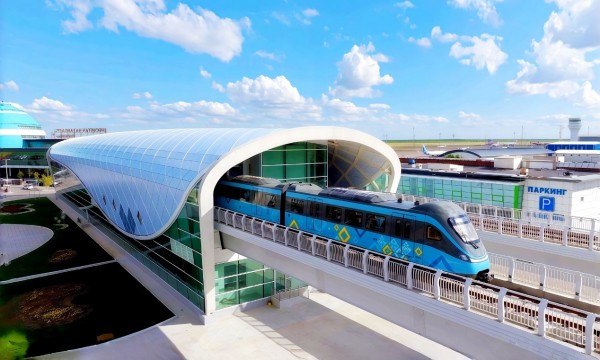
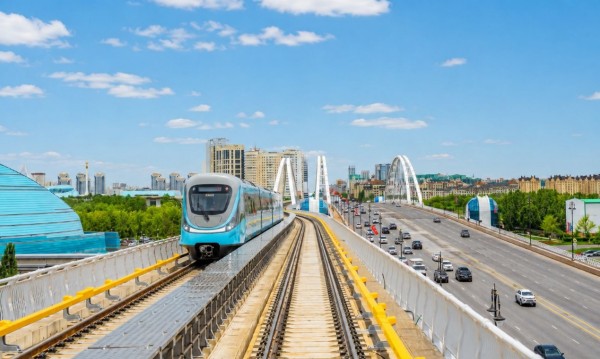
A train rolls out of a station at Phase Ⅰ of the light rail in Astana, the capital of Kazakhstan. [Photo/sasac.gov.cn]
Starting from the Nursultan Nazarbayev International Airport, Phase Ⅰ of the light rail stretches northward to the city’s new train station, spanning 22.4 kilometers in total. China Construction Sixth Engineering Bureau Corp., Ltd. undertook 18.34 kilometers in length, along which are 14 stations, 15 sections, and one depot. At speeds of up to 80 kilometers per hour, the train carries passengers to multiple landmark buildings and key functional zones across Astana.
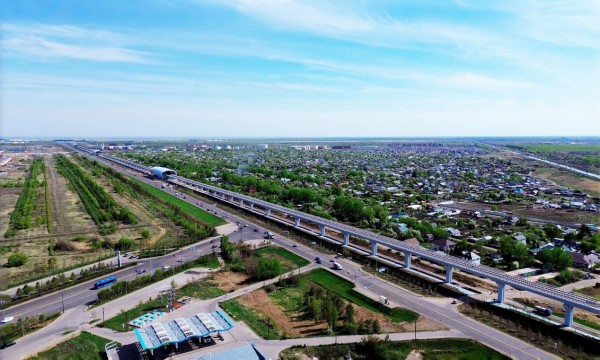
The newly opened light rail in Astana runs through residential areas and urban green spaces, enhancing local connectivity. [Photo/sasac.gov.cn]
The project faced severe challenges posed by extreme cold, a tight construction schedule, and complex geology. The team enforced stringent protocols for concrete curing and process control under low-temperature conditions, successfully overcoming the technical difficulties of rail transit construction in permafrost-like environments. Furthermore, by leveraging digital technologies such as building information modeling, smart welding robots, and prefabricated construction methods, the team significantly enhanced both construction quality and efficiency.
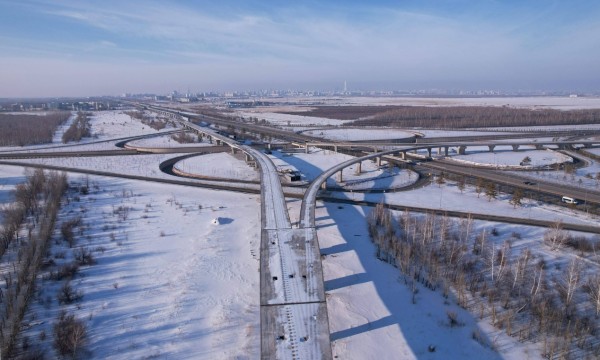
Phase Ⅰ of the light rail in Astana faces severe challenges posed by extreme cold, a tight construction schedule, and complex geology. [Photo/sasac.gov.cn]
The Ishim River Bridge stands as one of the most important sections along the entire line, featuring a 155-meter through-type basket-handle steel arch structure. All 2,598 metric tons of high-altitude cold-resistant steel components were prefabricated in North China’s Tianjin and transported over 4,600 kilometers to the site via a combined rail-road transport mode. Adopting a “building blocks” assembly approach, the team carried out precise welding and hoisting, significantly boosting construction efficiency while advancing energy conservation and environmental protection goals.
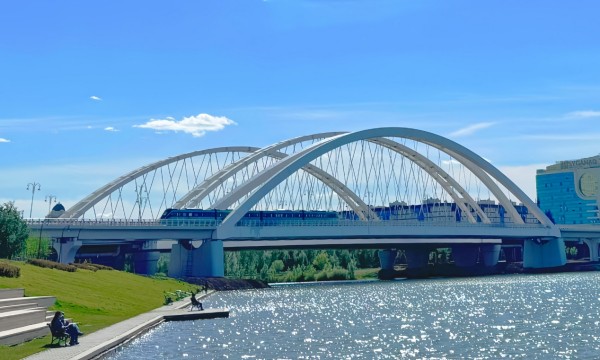
Ishim River Bridge along Phase Ⅰ of the light rail in Astana. [Photo/sasac.gov.cn]
The light rail has filled critical gaps in the city’s public transportation network and established a vital north-south transit artery. During peak hours, the line can reduce end-to-end commute times from 60 minutes — typical for private cars — to just 28 minutes.
Phase Ⅰ of the light rail in Astana effectively reduces commute times during peak hours. [Photo/sasac.gov.cn]
(Executive editor: Zuo Shihan)