On May 20, with the installation of the final steel tower segment, the main tower of the Jiangjunzhou Bridge was successfully topped out, signifying the completion of the bridge’s main structure.
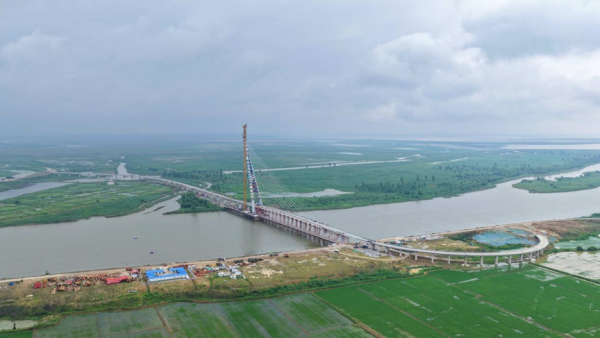
The Jiangjunzhou Bridge connects the banks of the Ganjiang River. [Photo/sasac.gov.cn]
The bridge, built by China Railway Major Bridge Engineering Group Co., Ltd., a subsidiary of China Railway Group Limited, is a part of the Poyang Lake tourist highway in Nanchang, the capital of Jiangxi Province.
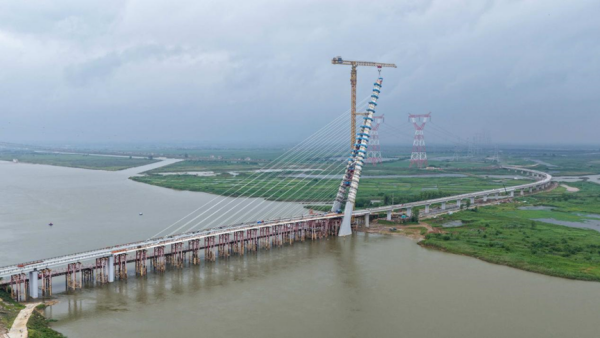
The A-shaped 173-meter main tower reaches 158 meters above the bridge. [Photo/sasac.gov.cn]
The bridge is 1,827 meters long, with a 225-meter main span. It has two opposite lanes, and its width ranges from 10 to 14 meters. Once completed, it will set two world records as the largest-span cable-stayed bridge without backstays and the tallest composite-structure cable-stayed tower.
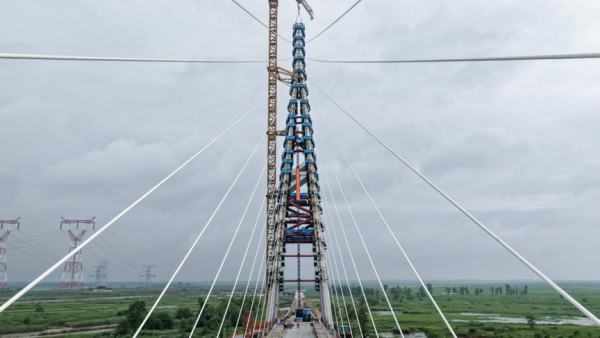
A crane installs the last steel segment. [Photo/sasac.gov.cn]
The greatest construction challenge was to maintain the balance between the main tower and the bridge girder. The construction team developed and implemented six major innovative measures, including a “girder-first, tower-second” construction approach, detailed structural force analysis in the early stages, and a full-process monitoring mechanism, thereby overcoming the challenges of load balance and structural stability in the tower-girder-cable system.
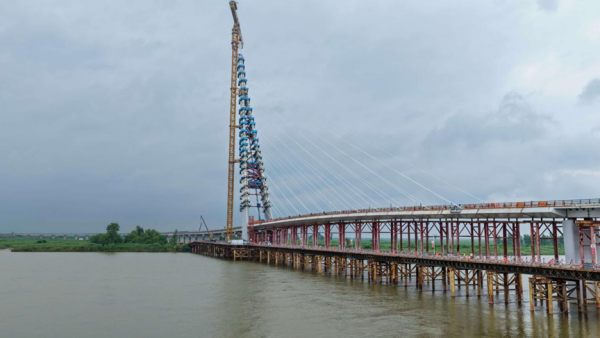
The world’s tallest composite-structure cable-stayed tower stands in place. [Photo/sasac.gov.cn]
To deal with longitudinal displacement challenges during the construction of the main tower, the construction team placed multiple monitoring points at different heights and key locations to achieve real-time oversight. In this way, thirty-nine steel segments were precisely installed and all the indicators of the topped-out main tower exceeded design specifications.
The Jiangjunzhou Bridge is a crucial project in Phase Ⅱ of the Poyang Lake tourist highway bridge works. Remaining ancillary works will now be carried out, including bridge deck paving, traffic safety facilities and lights. Once operational, the bridge will improve the transport network in the lake area and facilitate travel across the Ganjiang River. It will also play an important role in improving flood control, promoting environmental protection and advancing economic development in the region.
(Executive editor: Zuo Shihan)