Atop the snow-covered plateau, Power Construction Corporation of China (PowerChina) has once again pushed the limits of renewable energy construction. Recently, the phase Ⅰ project of the 100-megawatt solar power station in Nyemo County, Lhasa, the capital of Xizang Autonomous Region, has passed final acceptance inspection. Recognized as a global benchmark for ultra-high-altitude new energy development, the project is injecting strong impetus into Xizang’s clean energy development.
The site of the power station sits at an average elevation of over 4,700 meters, with its highest point exceeding 4,900 meters. It is also equipped with the world’s highest-altitude large-scale electrochemical energy storage station, built at an altitude of 4,784 meters.
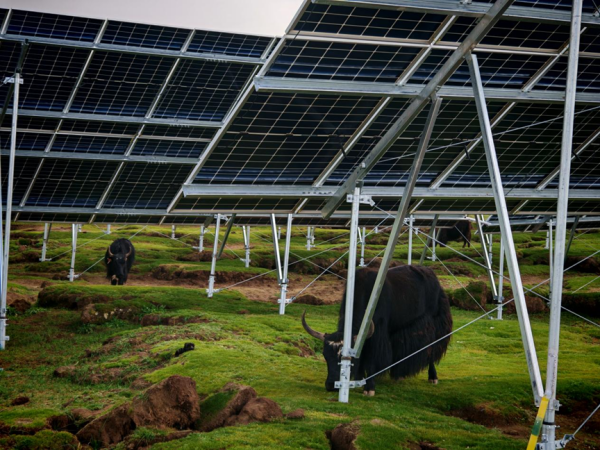
Yaks graze in the meadowland under solar panels at the phase I project of the 100-megawatt solar power station in Nyemo County, Lhasa, the capital of Xizang Autonomous Region. [Photo/sasac.gov.cn]
The power station was developed on an EPC basis by PowerChina Kunming Engineering Corporation Limited, with Sinohydro Bureau 9 Co., Ltd. serving as the main contractor. Both companies are subsidiaries of PowerChina.
During construction, the project team faced multiple challenges, including ultra-high altitude, extreme cold, oxygen deficiency, harsh weather conditions, and a fragile ecological environment. Through forward-looking planning and meticulous management, the construction team has ensured that safety, quality and schedule remained strictly under control.
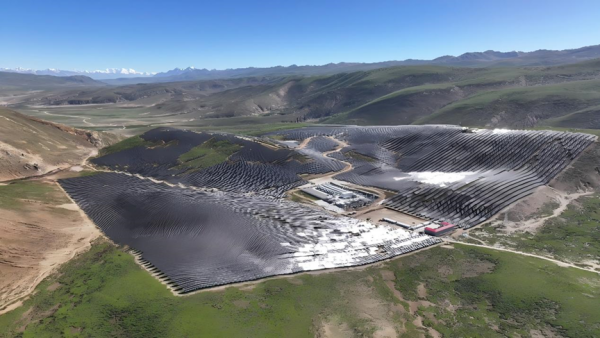
The phase I project of the 100-megawatt solar power station in Nyemo County, Lhasa, the capital of Xizang Autonomous Region. [Photo/sasac.gov.cn]
To overcome steep terrain, where conventional transportation was impossible and manual handling proved highly inefficient, the construction team has come up with a specialized construction method for ultra‑high‑altitude slopes. Innovative drone‑based hoisting and delivery were introduced, and the design of fully helical steel pile foundations was optimized to suit complex geological conditions — effectively securing the project’s safety, high quality, and on‑schedule delivery.
Prioritizing the ecological environment, the construction team collaborated with the Xizang Academy of Agriculture and Animal Husbandry Sciences to protect local meadowland. Integrating solar power generation with pasture conservation, the project has achieved both effective protection and timely restoration of high‑altitude meadows and set an ecological benchmark for new energy development on the plateau.
Once operational, the power station will generate about 200 million kWh of electricity annually, while reducing about 158,700 metric tons of carbon dioxide emissions. It will effectively ease local power shortages, reliably meet the electricity needs of local herders, and inject strong, sustained green impetus into the plateau’s economic and social development.
(Executive editor: Zuo Shihan)