The Long March 2F carrier rocket, carrying the Shenzhou-23 crewed spacecraft with astronauts Zhu Yangzhu, Zhang Zhiyuan and Lai Ka-ying aboard, blasted off on May 24 from the Jiuquan Satellite Launch Center in northwest China’s Gansu Province.
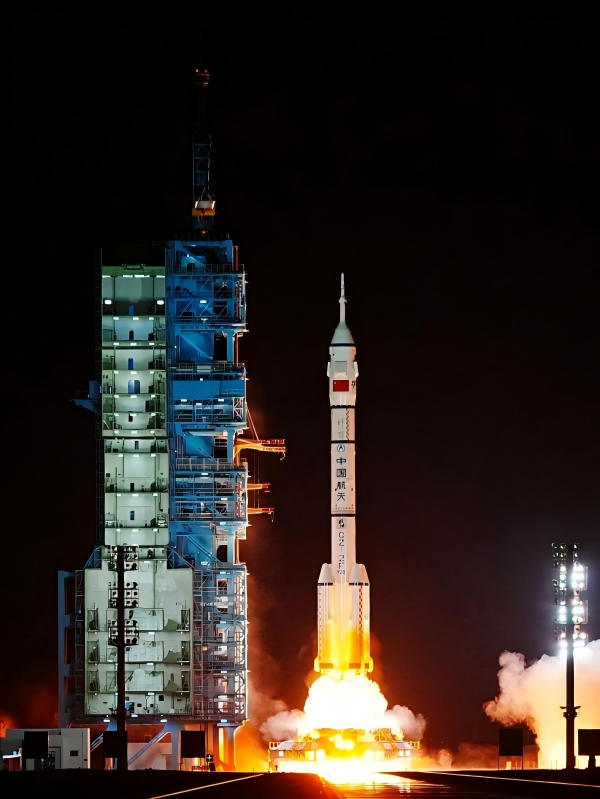
Long March 2F carrier rocket lifts off with Shenzhou-23 crewed spacecraft aboard on May 24 from Jiuquan Satellite Launch Center in Northwest China’s Gansu Province. [Photo/sasac.gov.cn]
After flying about three and a half hours, the spaceship docked with the front port on the Tianhe core module, the central piece of the Chinese space station. Its crew would later carry out a handover with the Shenzhou-21 crew currently aboard the station. Following the handover, the replaced astronauts will return to the Dongfeng Landing Site in North China’s Inner Mongolia Autonomous Region as scheduled.
Zhu Yangzhu, a spaceflight engineer who previously flew aboard Shenzhou-16, serves as mission commander. Zhang Zhiyuan, a spacecraft pilot, is making his first spaceflight. Lai Ka-ying, a female payload specialist from the Hong Kong Special Administration Region, is also on her first flight.
One of them will remain aboard the space station for a one-year mission, setting a new national record for the longest single-mission duration of a Chinese astronaut in orbit. The other two crew members will each conduct a standard six-month mission.
During their stay, the Shenzhou-23 crew will carry out multiple extra-vehicular activities and conduct a series of experiments and applications in space life and human research, microgravity physical sciences, and in-space new technology. They will also perform installation, commissioning, maintenance and repair of intra- and extra-vehicular equipment.
The Long March 2F carrier rocket was developed by China Academy of Launch Vehicle Technology, a subsidiary of China Aerospace Science and Technology Corporation (CASC), while the Shenzhou-23 crewed spacecraft is produced by China Academy of Space Technology, also a CASC subsidiary.
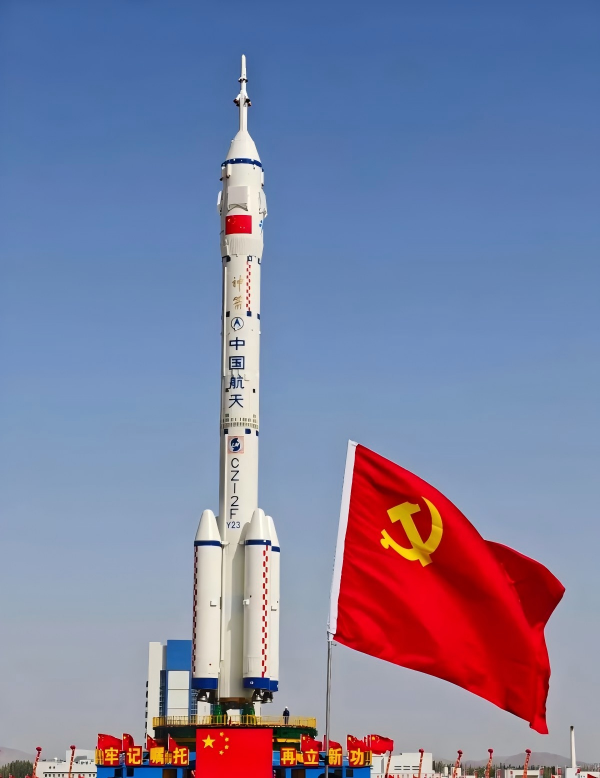
The combination of the Long March-2F carrier rocket and the Shenzhou-23 crewed spacecraft is rolled out to the launch pad at the Jiuquan Satellite Launch Center. [Photo/sasac.gov.cn]
In response to a suspected micrometeoroid and orbital debris strike on a Shenzhou-20 crew cabin window, the Shenzhou spacecraft team upgraded the window assembly on Shenzhou-23, which will enhance the spacecraft’s protection capability against space debris impacts. The Long March 2F team also made 16 technical configuration changes, further improving both the efficiency of the parameter design process and the quality control of the workflow.
This launch marks the 644th flight of the Long March carrier rocket series.
(Executive editor: Zuo Shihan)