China Railway Group Limited (CREC) connected the main sections of the Beijiang Grand Bridge on May 20. Before that, the bridge was the last unconnected part of the expressway from Qingyuan to Guangzhou in South China’s Guangdong Province.
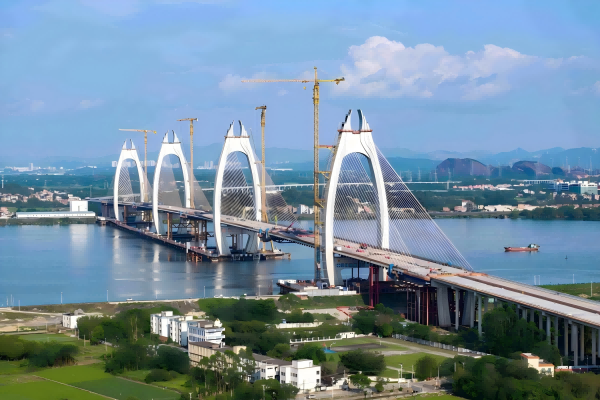
The construction site of the Beijiang Grand Bridge in South China’s Guangdong Province. [Photo/sasac.gov.cn]
The main bridge is 1,440 meters long and has a 360-meter main span. It is features four cable towers shaped like the feather of feng huang (phoenix), a auspicious bird in Chinese mythology.
The longest pile foundation of the bridge’s main pier is up to 102 meters deep, passing through multiple caves, fissures and inclined rocks. The vast and poorly filled karst caves are susceptible to external forces, meaning they could collapse or experience a water burst.
To address these issues, the construction team tailored every pile with a special plan and employed preventive safety methods for karst caves. Because of this, each of the 120 locations they bored for the pile foundation of the main pier was totally successful on the first try.
The unique shape of the cable towers also presented problems for the construction team. They adopted advanced technologies and equipment, including three-dimensional digital technology, a fully automated hydraulic climbing formwork system and an intelligent surveillance system, to ensure efficient and safe construction.
The intercity expressway connecting Qingyuan and Guangzhou is a crucial project initiated by the Guangdong provincial government during the 14th Five-Year Plan (2021-25) period. It spans 54 kilometers with a designed speed of 120 kilometers per hour.
Once operational, the expressway will be a critical supplement to the transportation network in the northern region of the Guangdong-Hong Kong-Macao Great Bay Area, reducing the transportation time across the area and facilitating regional integration.
(Executive editor: Zuo Shihan)