The superhard material industry in Central China’s Henan Province has transformed its advantages from manufacturing to innovation. Hu Laiyun, chief technician at China North Industries Group Corporation Limited, is a deputy to the National People’s Congress (NPC). At the fourth session of the 14th NPC, he made suggestions on deepening the coordination between enterprises, universities and research institutes and promoting the integration of technological and industrial innovation.
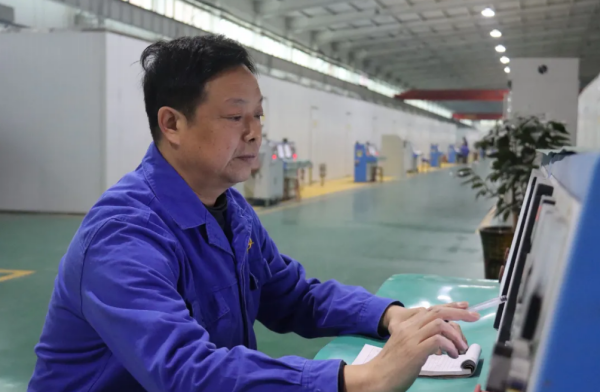
Hu Laiyun, chief technician at China North Industries Group Corporation Limited, is a deputy to the National People’s Congress. [Photo/sasac.gov.cn]
“Superhard materials are the core element of the new materials industry and can be used to make powerful cutters in the high-end manufacturing, aerospace and new energy industries,” Hu said. “More than 60 years ago, the country’s first synthetic diamond was produced in Henan, the cradle of China’s superhard material industry. Now, Henan’s output of synthetic diamonds and cubic boron nitride accounts for 80 percent and 95 percent of the national total, respectively. It also produces over 70 percent of the global industrial-grade synthesized diamonds.”
However, China’s superhard material industry faces urgent challenges that need to be addressed, despite holding a leading position in the global industry, Hu noted.
Hu pointed out that much high-end equipment in China’s superhard material industry cannot be produced domestically. He said that with the slow digital transformation, traditional manufacturing methods still dominate the industry, resulting in inadequate automation and digitalization in key production processes.
Hu also highlighted an inadequate reserve of interdisciplinary and highly skilled professionals, calling for further collaboration among industry, academia, research and end users. He said that more efforts should be made to enhance innovative resource sharing between enterprises, universities and research institutes and to facilitate the translation from technological breakthroughs into tangible outcomes.
Hu suggested that the chain-leading enterprises in Henan’s superhard material industry should play a leading role in building an innovation alliance. According to Hu, these enterprises should collaborate to make breakthroughs to tackle technological bottlenecks, promote the establishment of an advanced manufacturing cluster combining research on functional superhard materials and industrial chain expansion, and integrate the superhard material with the new energy, aerospace and quantum sensing industries, so as to expand the “diamond plus” business landscapes.
Hu suggested stepping up efforts to build national key laboratories in the field of superhard materials and granting them greater autonomy in conducting basic research and shaping technological roadmaps. He proposed supporting the building of a national data sharing platform for the superhard material sector and establishing an innovation system pertaining to materials, equipment and their application. He called for improving the mechanism of collaborative education among industry, academia, researchers, and end users and building modern industrial colleges through enterprise-university cooperation to foster versatile talents.
(Executive editor: Yuan Ting)