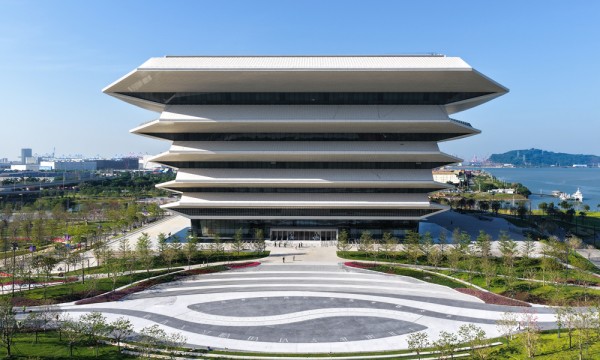
Qianhai Museum, a cultural landmark in Shenzhen, Guangdong Province, officially opens to the public on October 30. [Photo/sasac.gov.cn]
Qianhai Museum was officially opened to the public on October 30. The museum is a cultural landmark in Shenzhen, a major city in South China’s Guangdong Province, in the new era. The high-quality project, built by CSCEC Science and Industry, a subsidiary of China State Construction Engineering Corporation, greatly contributes to building the Guangdong-Hong Kong-Macao Greater Bay Area into a cultural hub.
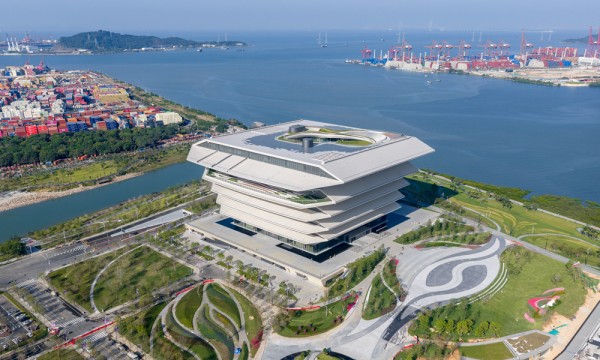
The museum serves as both an iconic landmark and a carrier of cultural heritage. [Photo/sasac.gov.cn]
The museum is located in the core zone of Qianhai Culture and Art Peninsula in Shenzhen and overlooks Qianhai Bay. It covers about 32,400 square meters and has a total floor area of approximately 126,000 square meters. By adopting the “Tree of Civilization, Beacon of the Times” design concept, it perfectly integrates into Shenzhen’s urban feature — a city linked with mountains and sea — thus serving as both an iconic landmark and a carrier of cultural heritage.
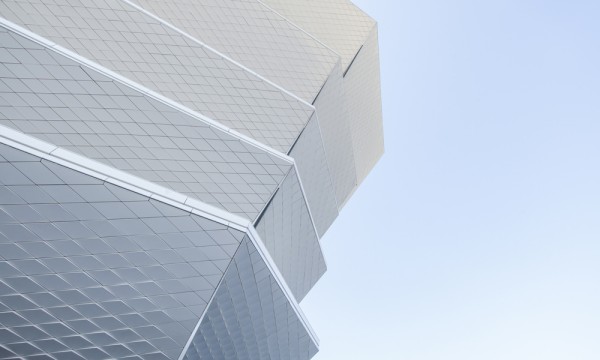
A view of the “scaled overlapping tiles” design. [Photo/sasac.gov.cn]
During construction, the project team overcame a host of structural challenges, such as building giant pillars that are tilted outward floor by floor and completing an arch structure at a height of 100 meters, and finished the construction to a high standard.
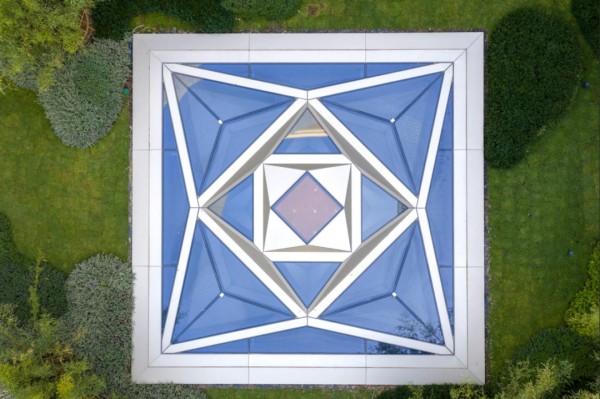
A view of the rooftop “Green Heart Garden”. [Photo/sasac.gov.cn]
The museum has a 40-meter-high atrium, a nearly 5,000-square-meter column-free “Mountain-Sea Theatre” and a rooftop “Green Heart Garden”. Through these features, the building itself can serve as a premium public cultural space for viewing, touring and leisure.
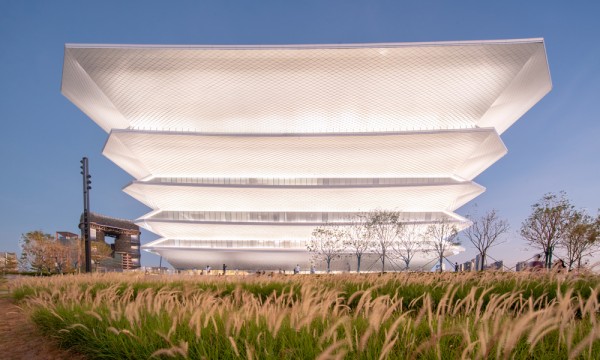
A view of the Qianhai Museum. [Photo/sasac.gov.cn]
Qianhai Museum now serves as an important venue to showcase Chinese civilization, tell stories of Shenzhen’s development, and deepen cultural exchanges between Shenzhen and the Hong Kong Special Administrative Region, and will become the city’s new cultural calling card to its global audience.