By October 30, China Oil & Gas Pipeline Network Corporation (PipeChina) had registered over 100 million metric tons of crude oil transported through its pipeline connecting Lanzhou, the capital of Northwest China’s Gansu Province, and Chengdu, the capital of Southwest China’s Sichuan Province.
The 880-kilometer pipeline is a key component in China’s unified oil and gas pipeline network, with an annual throughput reaching 10 million tons under 13.4 MPa of design pressure. This vital strategic corridor, delivering crude oil from northwestern to southwestern regions, has maintained safe and stable operation for 13 years.
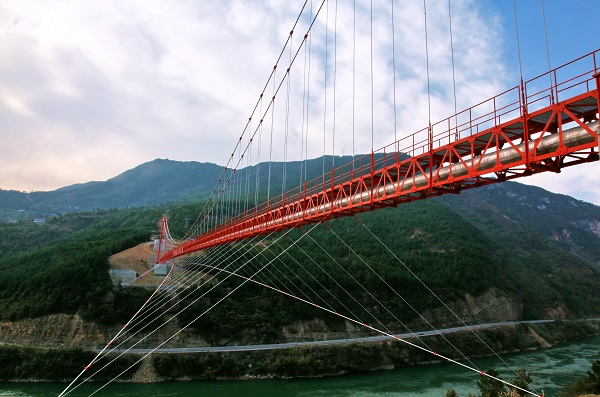
The Lanzhou-Chengdu Crude Oil Pipeline crosses the Bailong River, a secondary tributary of the Yangtze River. [Photo/sasac.gov.cn]
The pipeline traverses 45 mountain tunnels along its route, with a maximum elevation drop of 2,207 meters. When it was built, this long-distance pipeline had the highest design pressure and the largest elevation drop among pipelines of this type in China.
In recent years, the pipeline has sped up its digital and intelligent transformation. It uses one-click start-and-stop transport technology to achieve automated distribution. With that, the pipeline can independently conduct logical deduction on the timing of opening and shutting valves, automatically identify crude oil quality, dynamically regulate transport flow and complete data comparison in real time.
The pipeline is equipped with a geological hazard monitoring and early warning platform, which can perform round-the-clock online monitoring of the areas possibly affected by landslides and floods. The platform has more than an 80 percent accuracy rate for anomaly identification, capable of generating professional analysis reports within 30 seconds and immediately sending alerts to operation and maintenance staff.
PipeChina efficiently coordinates with other companies along the pipeline to ensure integrated energy supply. It collaborated with PetroChina Sichuan Petrochemical Co., Ltd., a subsidiary of China National Petroleum Corporation, to blend the crude oil produced in the Changqing Oilfield into the oil flow of the Lanzhou-Chengdu Pipeline, in order to overcome difficulties in crude oil transportation under low winter temperatures.
By upgrading the section connecting Pengzhou, a county-level city under the administration of Chengdu and the end of the Lanzhou-Chengdu Pipeline, with the Tianpeng Oil Depot, the corporation also forms an integrated oil supply chain that can deliver crude oil to Sichuan, process it locally and transport oil products out of the province.
The pipeline can transfer crude oil from Central Asia, such as Kazakhstan, and Northwest China’s Xinjiang Uygur Autonomous Region to Pengzhou’s gigantic oil refinery, whose oil products can meet more than a quarter of Sichuan’s consumption. Through this, it plays a pivotal role in boosting regional economic development and safeguarding national energy security.
(Executive editor: Zuo Shihan)