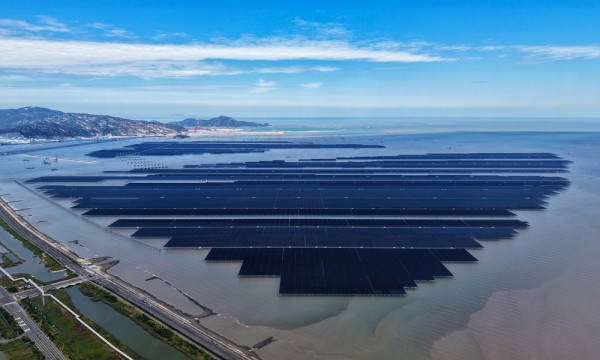
The Tianwan 2-gigawatt tidal flat PV demonstration project, built by China National Nuclear Corporation, is the largest offshore PV project in China. [Photo/sasac.gov.cn]
The Tianwan 2-gigawatt tidal flat PV demonstration project, the largest offshore PV project in China, had more than 1 GW of installed capacity connected to the grid, marking the completion of more than half of the project’s grid connection capacity.
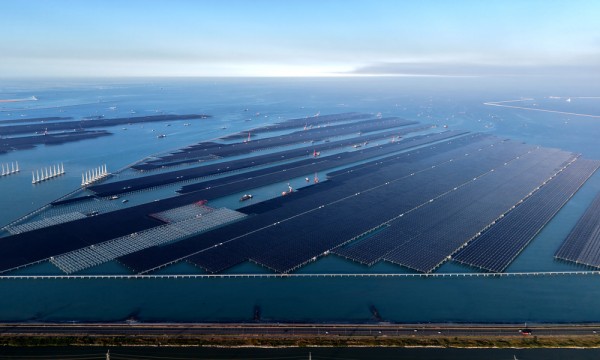
The project also stands as the world’s first new energy demonstration project integrating nuclear power, thermal energy, solar power and energy storage in a complementary energy system. [Photo/sasac.gov.cn]
The project, occupying approximately 28,300 mu (about 1,887 hectares) of sea area, is located at the Tianwan Nuclear Power Plant in Lianyun District of Lianyungang, a city in East China’s Jiangsu Province, where warm water discharged from the plant is released into the sea. It is listed among China’s third group of large-scale new energy bases and the world’s first demonstration project integrating nuclear power, thermal energy, solar power and energy storage in a complementary energy system.
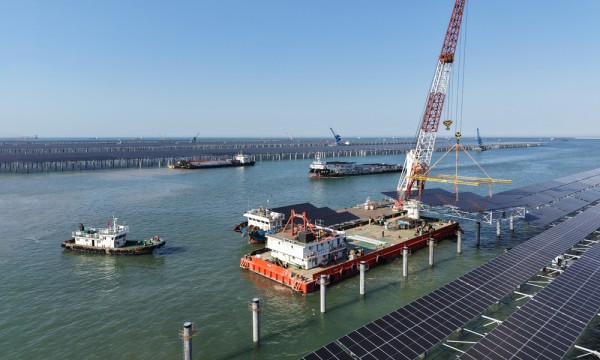
A view of the Tianwan 2-gigawatt tidal flat PV demonstration project. [Photo/sasac.gov.cn]
The project adopted a construction strategy of overall development with phased grid connection. The first group of its generating units was connected to the grid in January 2025, and its cumulative installed capacity had reached 1.5 gigawatts by September of this year.
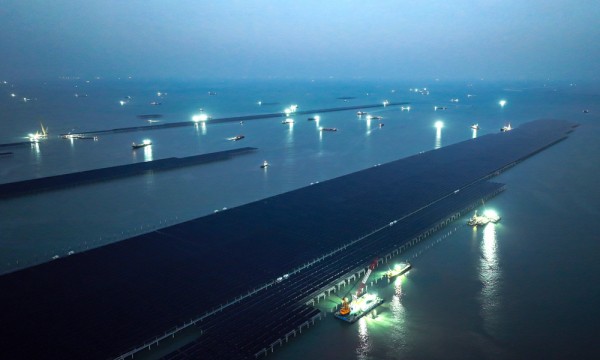
The project will steadily supply clean energy to underpin local economic and social development. [Photo/sasac.gov.cn]
The project’s booster substation on land has been completed, and its supporting energy storage station achieved full-load grid connection and was put into operation in June 2024. Upon reaching full operation, the project is expected to generate more than 2.2 billion kilowatt-hours of electricity annually, equal to saving 681,200 metric tons of standard coal and cutting carbon dioxide emissions by 1.77 million tons.
(Executive editor: Zuo Shihan)