The Hangzhou Bay Cross-Sea Railway Bridge, the world’s longest cross-sea railway bridge, has achieved two construction milestones, with its southern and northern navigation channel bridges respectively achieving closure.
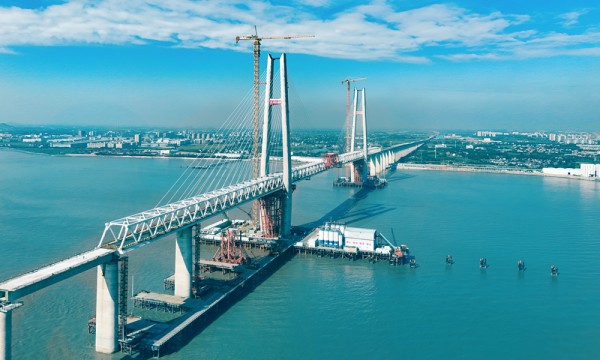
The southern and northern navigation channel bridges of the Hangzhou Bay Cross-Sea Railway Bridge have achieved closure. [Photo/sasac.gov.cn]
The southern navigation channel bridge was designed by China Railway Major Bridge Reconnaissance & Design Institute Co., Ltd., a subsidiary of China Railway Group Limited (CREC), while the northern one was built by China Railway Major Bridge Engineering Group Co., Ltd., also a CREC subsidiary.
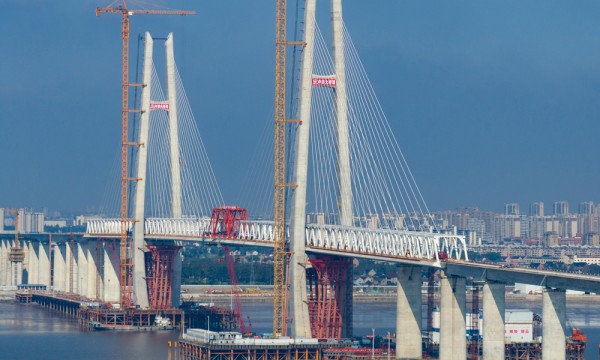
The Hangzhou Bay Cross-Sea Railway Bridge is 29.2 kilometers long, forming a crucial section of the Nantong-Ningbo High-Speed Railway. [Photo/sasac.gov.cn]
The 29-kilometer-long bridge, a crucial section of the Nantong-Ningbo High-Speed Railway, consists of northern, central, and southern navigation channel bridges, as well as mid-sea approach bridges and shoal-area approach bridges. Designed for a speed of 350 kilometers per hour and built to the highest standard, the bridge will feature double-track ballastless railways.
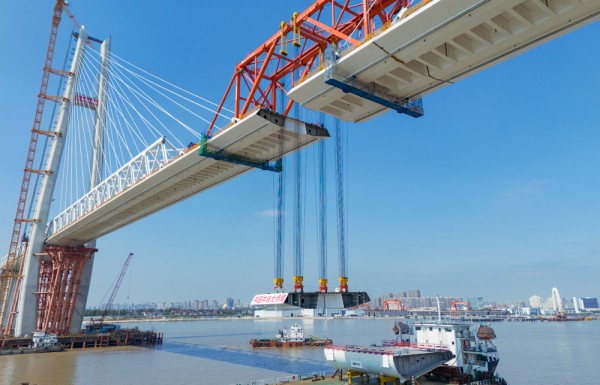
A view of the navigation channel bridge during its closure. [Photo/sasac.gov.cn]
The southern navigation channel bridge was the first of the three channel bridges to complete closure. It is a twin-pylon cable-stayed bridge with a double cable-plane configuration and a steel-truss composite girder, measuring 814.5 meters in length and with a main span of 364 meters.
The biggest technical challenge for its closure was millimeter-level alignment. The project team adopted the unstressed state method and employed a complete set of construction techniques, including longitudinal jacking of the main girder and precise adjustment of the closure gap. It also carried out multi-dimensional sensitivity analysis on various parameters and formulated plans for closure adjustment. Based on the data measured at the construction site, it dynamically calculated and calibrated parameters, finally achieving the high-precision closure of the main girder.
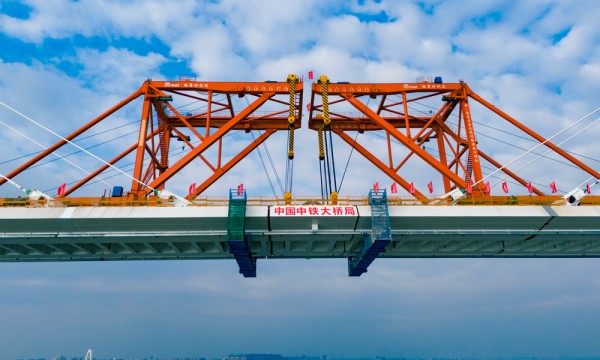
A view of the navigation channel bridge during its closure. [Photo/sasac.gov.cn]
The northern navigation channel bridge measures 932.7 meters, with a main span of 450 meters. It is the world’s longest-span cable-stayed bridge with ballastless track designed for high-speed rail currently under construction. To tackle construction challenges posed by complex marine conditions and the super-long composite girder consisting of steel boxes as well as trusses, the project team collaborated with its professional partners to develop a full set of construction technologies, underpinning the high-precision, safe and efficient construction of the steel girder.
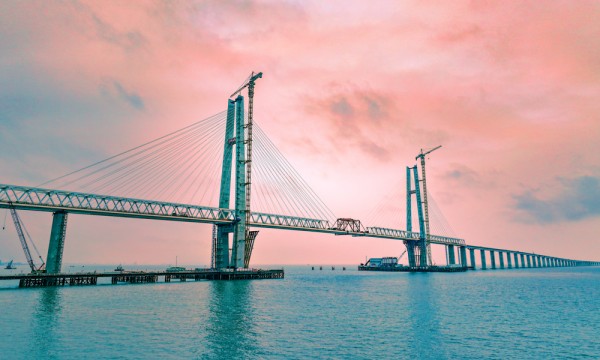
A view of the navigation channel bridge during its closure. [Photo/sasac.gov.cn]
The Nantong-Ningbo High-Speed Railway is a key section of the coastal corridor in China’s “Eight Vertical and Eight Horizontal” high-speed railway network. Once put into operation, it will connect with multiple lines, including the Yancheng-Nantong High-Speed Railway, Shanghai-Kunming High-Speed Railway and Ningbo-Taizhou-Wenzhou Railway.
It will facilitate the building of the “Yangtze River Delta on Rail”, optimize the regional railway network, improve travel convenience for residents along the route, and boost high-quality, integrated development of the Yangtze River Delta.
(Executive editor: Zuo Shihan)