China Three Gorges Corporation (CTG) released on October 20 more than 810,000 artificially bred fry of Coreius guichenoti, a unique Chinese fish species, into the reservoir area of the Wudongde Hydropower Station on the Jinsha River in the city of Panzhihua in Southwest China’s Sichuan Province.
The event was part of the corporation’s plan to successively release such fish on a large scale at three separate sites this year in the hope of restoring and increasing the fish stock. It’s also its second such activity this year.
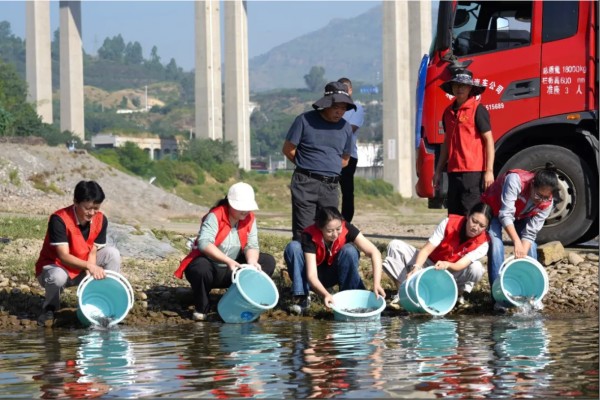
Volunteers release larger-size fry into the Jinsha River. [Photo/sasac.gov.cn]
The Coreius guichenoti, a rare fish endemic to the upper Yangtze River, is classified as China’s second-class protected animal. Its captive breeding and large-scale propagation have long been recognized as a tough challenge.
CTG has carried out sustained, extensive research on key technologies to protect the fish and has established a full-fledged conservation system that covers broodstock protection, large-scale propagation, disease prevention and control, standardized fry rearing, tagged release and long-term monitoring and assessment, laying a solid foundation for large-scale enhancement and release for this rare species.
This year, CTG has pioneered a new conservation model featuring coordinated restoration of the main stream and tributaries. Under this model, the ecological functions of the main river channel, tributaries and the tail of the reservoir are coordinated to facilitate fish migration corridors and build a complex habitat that is helpful to population reconstruction and gene exchange across the entire watershed. The new method goes far beyond the limitations of releasing fry to a single river section.
To scientifically evaluate the outcomes of this release, CTG has tagged the fry using four tagging technologies, forming an integrated tagging system that supports on-site identification and genetic analysis. Researchers will conduct full-cycle monitoring through recapture sampling, environmental DNA surveillance and other measures, so as to soundly align scientific conservation and precise release.
(Executive editor: Zuo Shihan)