It’s been a decade since Xinjiang Chemical Co's coal-to-olefins project — Xinjiang's first and still its only operational one — was successfully commissioned on the first attempt on October 3, 2016, producing qualified polyolefin products. The project has a designed capacity of 680,000 metric tons per year.
The past decade marked multiple significant transformations where coal has been turned from a fuel into feedstock for chemical production, Xinjiang has achieved self-reliance in core technology, and a Central Asian export brand has taken hold.
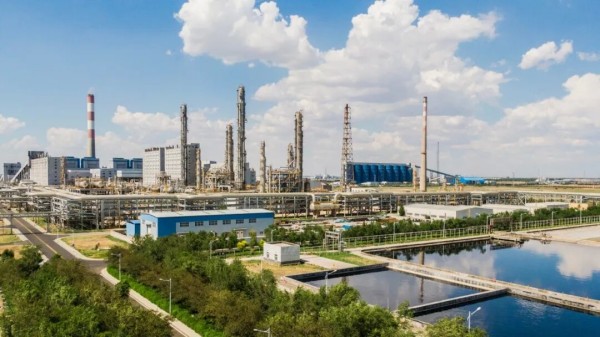
A panoramic view of Xinjiang Chemical Co, a subsidiary of China Energy Investment Corporation Co., Ltd. [Photo/sasac.gov.cn]
Technology: Achieving Self-Reliance
In the project's early years, there had been a major challenge: Existing methanol-to-olefins (MTO) units suffered from low reaction yields and high energy consumption. The design team developed Shenhua Methanol-to-Olefins (SHMTO), a proprietary technology with independent intellectual property rights. Subsequent optimization brought per-unit energy, water and coal consumption to levels that lead the industry.
Faced with long lead times and high costs for catalysts used in methanol synthesis units, Xinjiang Chemical teamed up with research institutions to develop domestic catalysts for large-scale methanol synthesis plants, which were verified through performance testing by the China Petroleum and Chemical Industry Federation, marking a major step toward independent control of a key catalyst in the coal chemical industry.
More domestically produced core equipment followed: polypropylene powder conveying fans, gasifier process burners and polyethylene extruder templates. Each localization effort is a step away from reliance on imports, and together they set a demonstrative example for independent innovation across Xinjiang's coal-chemical industry.
Exports: A Regional Brand Built from Scratch
Xinjiang Chemical turned its geographical position into a market advantage, starting exports of polyolefin products in 2022. China-Central Asia railway launched a dedicated intermodal transport service for its polyolefin products in 2023, with export volume doubling in 2024 and Central Asian customers starting full-train procurement in 2025.
By 2026, the "blue bag" brand image — a nickname among Central Asian customers for the company's blue-packaged polyolefins — has taken hold and reached markets in South America, Africa, Europe and Southeast Asia. As of September 2026, cumulative polyolefin exports exceeded 190,000 tons.
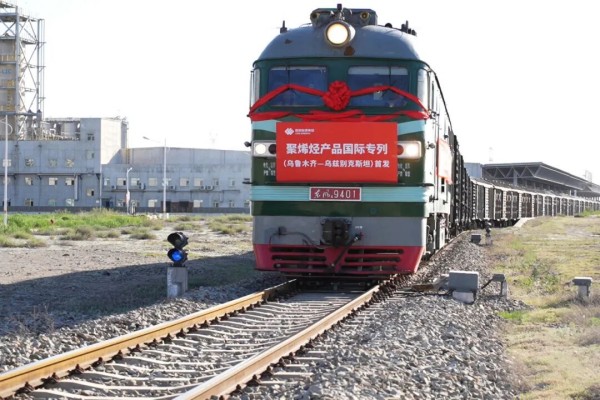
Xinjiang Chemical's polyolefin products depart on the first dedicated train to Uzbekistan. [Photo/sasac.gov.cn]
Last year, Xinjiang Chemical sent a delegation to downstream enterprises across Central Asia to help resolve processing and application problems. The head of a food packaging plant in Uzbekistan praised the products’ stable quality and excellent performance. In 2026, an Uzbek customer walked into the company with the "blue bag" in hand to place orders in person — a vote of confidence no marketing campaign could buy.
Behind its market expansion sits a broader product strategy: six series of high-value-added polyolefins tailored to end users’ increasingly customized and high-end needs, advancing clean and efficient coal utilization.
Green production: Emissions down, resource recovery up
Environmental performance has been a key pillar of Xinjiang Chemical’s high-quality development. It has invested heavily in upgrading environmental facilities and advanced air pollution control through projects including the upgraded emission standards of VOCs, with emission indicators below national ultra-low emission standards.
The company has advanced water conservation through equipment retrofitting, water-saving and plume-abatement technologies, sludge drying and crystallized salt quality improvement. In 2024, it was named a water efficiency leader by the Ministry of Industry and Information Technology, the first in the coal-to-olefins industry.
The company has implemented projects such as gasification slag dewatering and carbon dioxide adsorption upgrading, achieving full resource utilization of crystallized salt and the harmless treatment, reduction and resource utilization of solid waste.
To support China's goals of peaking carbon emissions and achieving carbon neutrality, the company built in 2023 the largest carbon capture, utilization and storage (CCUS) supporting pipeline project in Xinjiang's coal-chemical industry at the time. As of August 2026, the company has captured over 660,000 tons of carbon dioxide for offsite delivery, with a carbon dioxide capture capacity of 1.1 million tons per year.
Ten years on, the project remains Xinjiang's only operational coal-to-olefins facility, and its exports have made it part of Xinjiang's trade with Central Asia and beyond.
(Executive editor: Zuo Shihan)