In a landmark infrastructure development in eastern China, the final one of all 92 precast box girders was installed on October 14 on the northern (Haiyan-side) offshore non-navigable section of the Hangzhou Bay Cross-Sea Railway Bridge.
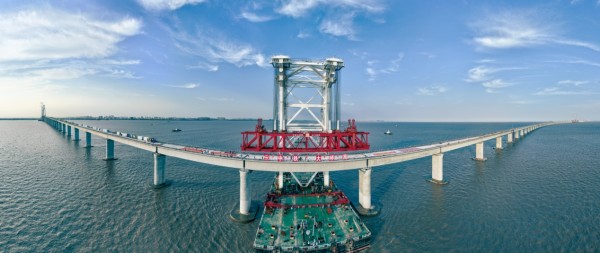
A view of the precast box girder installation site. [Photo/sasac.gov.cn]
The bridge is a crucial segment of the Nantong-Suzhou-Jiaxing-Ningbo High-Speed Railway. Upon completion, it will become the world’s longest sea-crossing bridge for high-speed rail.
The construction milestone was marked by the exact placement of the final precast box girder between piers 33 and 34, completing the main superstructure of the 7.18-kilometer section.
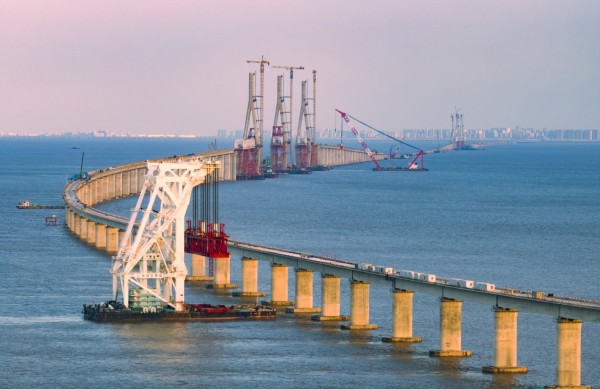
A view of the precast box girder installation site. [Photo/sasac.gov.cn]
China Railway Major Bridge Engineering Group Co Ltd (MBEC) — a subsidiary of China Railway Group Limited — is responsible for the construction of the Hangzhou Bay Cross-Sea Railway Bridge under contract section TYZQ-3 of the Nantong-Suzhou-Jiaxing-Ningbo High-Speed Railway project.
The offshore non-navigable bridge section uses concrete box girders with spans of 80 meters and 60 meters, with the heaviest single girder weighing 2,804 metric tons. The 80-meter-span girder is currently the longest-span prestressed concrete box girder being used in high-speed railway bridge construction worldwide.
The project is located in Hangzhou Bay, one of the world’s three major macrotidal bays. As such, the area presents formidable construction challenges, including large tidal ranges, swift currents, severe seabed scour and frequent strong winds — all of which severely limit the available time for marine operations.
These conditions make construction in the bay particularly challenging. The offshore installation of such heavy girders also requires stringent control over transportation, lifting, positioning accuracy and structural stability.
To overcome these challenges — including shallow water, strong currents, exceptionally heavy girders and narrow construction windows — the project team adopted a construction method in which the girders are first installed as simply supported spans and then followed by casting of wet joints and crossbeams. The team also emphasized factory-based production, prefabricated assembly and intelligent construction management.
At an intelligent precast girder production yard, a digital twin system was deployed to monitor and manage the entire box girder manufacturing process. Intelligent monitoring covers the full production chain — including reinforcing steel fabrication, concrete placement to curing, prestressing and girder transfers. That all helps ensure the quality and safety of the precast girders.
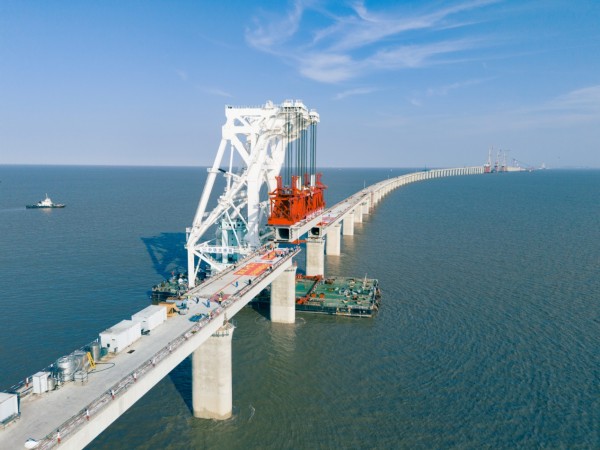
A view of the precast box girder installation site. [Photo/sasac.gov.cn]
For transportation, the team deployed coordinated, self-propelled modular transporters configured with 64 axles, each rated for a load of 60 tons. The precision of synchronized lifting and lowering has improved from the conventional ±10 millimeters to ±1.5 mm.
Once transported by the modular transporters to the marine terminal, the girders are handled by the Tianyi, an integrated girder transport and erection vessel operated by the contractor, MBEC. The vessel carries out the lifting, transportation and erection of the girders offshore.
The construction team accurately calculated the tidal variations and developed tailored schedules for girder lifting, transport and erection according to tidal conditions. By doing so, it controlled installation deviations to within millimeters — ensuring a precise alignment between the girder axis and the centerline of the bearings.
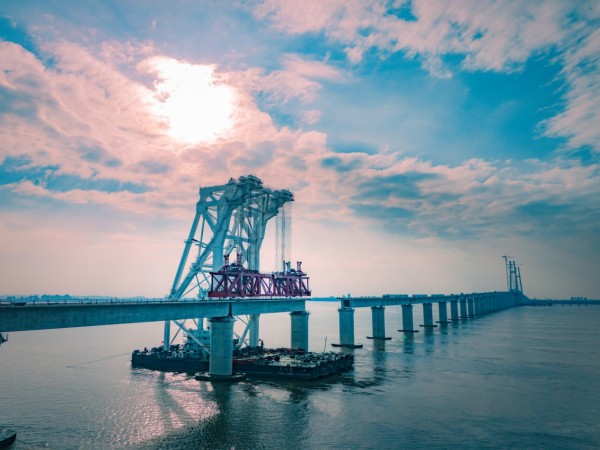
A view of the precast box girder installation site. [Photo/sasac.gov.cn]
As a critical project on the Nantong-Suzhou-Jiaxing-Ningbo High-Speed Railway, the Hangzhou Bay Cross-Sea Railway Bridge will establish a high-speed rail link across Hangzhou Bay when completed.
It’s expected to significantly reduce travel times between Ningbo and major cities such as Shanghai and Suzhou, further strengthen the Yangtze River Delta high-speed railway network, and promote closer coordination between northern and eastern Zhejiang Province.
Overall, the project will provide a major boost to the integrated, high-quality development of the Yangtze River Delta.
(Executive editor: Zuo Shihan)