On October 13, the world’s first commercial ship-to-ship green ammonia bunkering operation was successfully completed at an anchorage in Zhoushan City, in East China’s Zhejiang Province. The 1,000 metric tons of green ammonia used in the bunkering operation were produced at Songyuan Hydrogen Energy Industrial Park, also known as “Qingqing No 1”.
“Qingqing No 1”, the world’s largest integrated project for green hydrogen, ammonia and methanol, is operated by China Energy Engineering Corporation Limited (CEEC) in Songyuan City in Northeast China’s Jilin Province. The green ammonia was transported from there to Nanjing Port in East China’s Jiangsu Province with special tank cars, and then shipped to Zhoushan Port aboard the Shenghang Yongle, the world’s first dedicated liquid ammonia bunkering vessel, to fuel the Mineral Europa, a 210,000-ton-class ammonia-powered vessel owned by the Belgian maritime group CMB.TECH.
Following the bunkering operation, the Mineral Europa is expected to depart Zhoushan and head across the Pacific Ocean to Australia for commercial shipping operations.
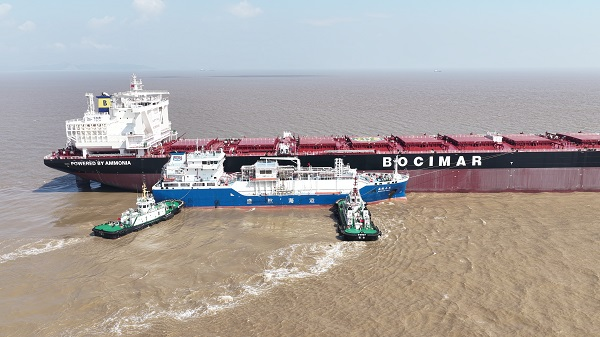
A view of the ship-to-ship bunkering operation. [Photo/sasac.gov.cn]
Green ammonia can be produced on a massive scale using wind, solar, water, and air, achieving near-zero carbon emissions throughout its life cycle. Furthermore, it boasts high volumetric energy density, is easy to liquefy and transport, and can be seamlessly integrated into existing hazardous chemical storage and transportation infrastructure.
Ammonia, one of the most commercially viable zero-carbon fuels that can help achieve deep decarbonization of ocean-going shipping, relies on stringent requirements for storage, transport and offshore bunkering. Safe ship-to-ship ammonia bunkering is a critical threshold for the commercialization of this marine fuel.
“To complete ship-to-ship bunkering at anchorage, a dedicated bunkering vessel pulls alongside the receiving vessel and directly transfers fuel to it through low-temperature, corrosion-resistant hoses. The method requires no port berths or dedicated onshore terminals. The whole process can take place when the receiving vessel unloads cargo, waits for berths or takes a detour. Compared with in-port bunkering, anchorage-based ship-to-ship bunkering cuts transport and logistics time by 8 to 12 hours, serving as a more efficient bunkering measure on key waterways,” said an executive from China Energy Engineering Group Hydrogen Energy Co, Ltd, a CEEC subsidiary.
This successful bunkering comprehensively validates China’s green ammonia storage, transport and bunkering system under rigorous safety standards.
(Executive editor: Zuo Shihan)