Tie Jian Da Qiao Zhuang 1, the world’s largest pile-driving vessel financed and built by the China Railway Construction Corporation (CRCC), departed on September 27 from the Lyusi port in East China’s Jiangsu Province for the Bay of All Saints in Brazil’s state of Bahia to support construction of the Salvador-Itaparica Bridge, the largest cross-sea, cable-stayed bridge in Latin America.
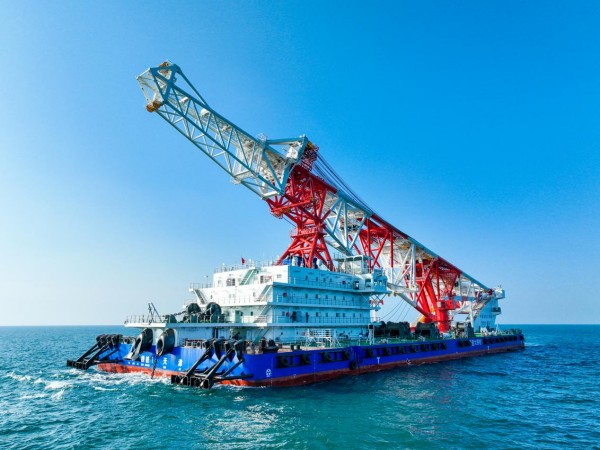
Tie Jian Da Qiao Zhuang 1 is the world’s largest pile-driving vessel. [Photo/sasac.gov.cn]
After completing a dedicated transport plan, route planning and risk assessments, the vessel is scheduled to travel 11,300 nautical miles, passing through the Strait of Malacca and the Cape of Good Hope, before entering the South Atlantic Ocean and reaching waters off Recife, the capital of northeastern Brazil’s Pernambuco state, on a voyage expected to take about 45 days.
The Salvador-Itaparica Bridge spans Brazil’s famed Bay of All Saints, with the main bridge’s pile-foundation work to be undertaken in waters 64 meters deep and amid complex marine geological conditions.
Tie Jian Da Qiao Zhuang 1 is currently the world’s largest pile-driving vessel by the pile-frame height of 156 meters, pile-lifting capacity of 700 tons, and the maximum operating depth of 70 meters. It holds global records for the tallest pile frame, largest pile lifting capacity and deepest operating water depth, and is able to overcome key limitations of conventional pile-driving vessels — limited reach, poor positioning accuracy and insufficient stability — in deep waters and complex sea conditions.
Technologically, the vessel has achieved two world-first innovations. For one, it is the first large pile-driving vessel to combine dynamic positioning and a mooring positioning system. Mooring positioning secures the hull by casting anchors at four corners into the seabed, while the dynamic positioning system senses wind, wave and current conditions in real time, supporting bow and stern thrusters to deliver counter thrust to fine-tune the vessel’s positioning. Combined with China’s domestically developed high-precision BeiDou Navigation Satellite System, the technology enables pile-driving positioning accuracy at the centimeter level.
For the other, it is also the first pile-driving vessel to use a closed-loop hydraulic system for its main cylinders. The domestically developed system converts the potential energy generated when the pile frame is lowered or tilted forward into electrical energy, achieving an energy recovery rate of up to 40 percent.
The Salvador-Itaparica Bridge is funded, constructed and operated by a concession company jointly established by China Civil Engineering Construction Corporation under CRCC and three other shareholders. The bridge has a main span of 682 meters and an overall length of 46.8 kilometers. When it enters into operation, travel time between Salvador and Vera Cruz is expected to be cut dramatically from the current one hour by ferry to just 15 minutes, and the transportation distance for goods such as grain, cotton and fruit produced in western Bahia state will be shortened by 200 kilometers.
In recent years, China’s domestically built pile-driving vessels are becoming taller and capable of working at greater depths. As a growing number of high-end marine engineering vessels and equipment are deployed overseas, Chinese equipment is expected to play a greater role in marine engineering projects around the world.
(Executive editor: Zuo Shihan)