The first two units of the Dashixia Water Control Project in the Xinjiang Uygur Autonomous Region were successfully connected to the grid and began power generation, marking a major milestone for the “super project” nestled deep in the Tianshan Mountains.
China Gezhouba Group Co., Ltd., a subsidiary of China Energy Engineering Corporation Limited, invested in and built the comprehensive water control project. With the operational launch of the first two units, the project has officially begun delivering on its designed ecological, irrigation, flood control and power generation benefits.
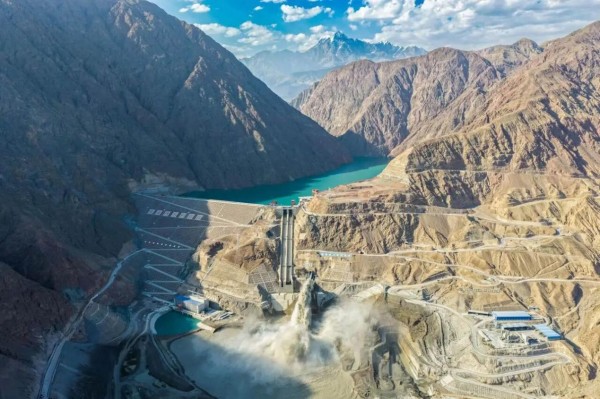
A view of the Dashixia Water Control Project in Northwest China’s Xinjiang Uygur Autonomous Region. [Photo/sasac.gov.cn]
The project’s 247-meter dam is currently the world’s highest concrete-faced sand-gravel dam. Embankment filling began in September 2021, with a total filling volume of 18.9 million cubic meters, equivalent to the volume of 7,000 standard swimming pools.
The power station has a total installed capacity of 750 megawatts and is equipped with three Francis turbine generating units, each with a capacity of 250 megawatts. These are China’s first Francis units fitted with cylindrical valves tailored for high-head and sediment-laden conditions, capable of operating in harsh environments featuring large water head variations, high sediment concentration and hard sediment particles.
Despite severe environmental challenges — including an arid, windy climate and rugged, landslide-prone geology — the construction team utilized digital management to achieve ultra-high-precision installation of core components. During trial operations, key indicators such as unit vibration, swing, and bearing temperatures demonstrated excellent performance.
Once fully operational, the Dashixia project will generate an average of 1.89 billion kilowatt-hours annually, enough to meet the electricity needs of some 600,000 households for a year. It will also undertake peak-shaving tasks for power systems across southern Xinjiang, effectively easing regional power supply pressures.
Beyond power generation, the facility is expected to deliver 3.42 billion cubic meters of water to the Tarim River every year, alleviating water shortages for over 8 million mu (about 533,000 hectares) of farmland in the Aksu River basin. It will also elevate the downstream flood control standard from a 10-year return period to a 50-year return period, significantly boosting the region’s agricultural modernization and disaster mitigation capabilities.
(Executive editor: Zuo Shihan)