The road section of the Shituo Yangtze River Bridge, a key project on the Chongqing-Wanzhou high-speed railway, closed its main span on September 26 in Southwest China’s Chongqing Municipality.
The road section, built by China Railway Group Limited, will lay a solid foundation for subsequent construction work, such as deck paving and auxiliary facility installation.
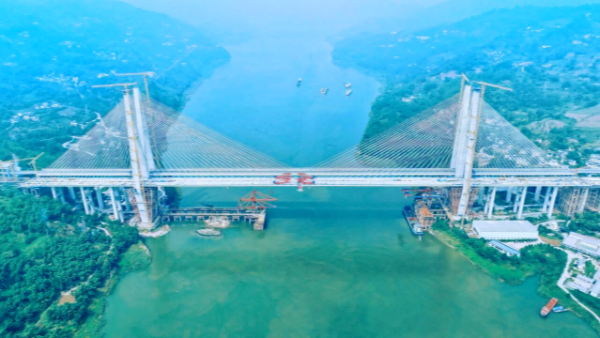
The Shituo Yangtze River Bridge, in Chongqing’s Fuling District, measures 1,416.9 meters in length, with the main bridge stretching 1,056 meters. [Photo/sasac.gov.cn]
Once completed, the bridge is expected to set four world records. It will become the world’s first dual-linked pylon for combined road-and-rail bridge, and the first to adopt a same-level separated-deck design for both highway and railway traffic. The bridge’s No. 6 main pylon stands 253 meters tall, making it the world’s tallest dual-linked pylon, while the 608-meter main span is the longest ever on a hybrid-girder cable-stayed bridge that has the road and rail on the same level.
The project team deployed an intelligent monitoring system to conduct round-the-clock, real-time monitoring of steel beam posture, stress and deformation. The system could automatically recognize millimeter-level deviations and issue timely warnings, boosting construction precision and efficiency.
The team also built a smart construction management platform that integrates multi-dimensional data covering construction progress, safety, quality, materials and other aspects. It enabled information sharing and collaborative management among all participating parties. In this way, the team transformed conventional bridge construction methods into a digital and intelligent approach.
The 254-kilometer Chongqing-Wanzhou high-speed railway, of which this bridge is a critical section, is part of China’s “eight vertical and eight horizontal” high-speed rail network. It connects Chongqing East Station with Wanzhou North Station in Chongqing, supporting trains that run at 350 km per hour.
Once operational, the railway will significantly cut travel time between Chongqing’s central urban area and the towns of the Three Gorges Reservoir region. It is expected to further advance the development of the Chengdu-Chongqing twin-city economic circle and the Yangtze River Economic Belt.
(Executive editor: Zuo Shihan)