The Fanshi Offshore Wind Power Project in Yangjiang, South China’s Guangdong Province, went into full operation on September 24. The facility, operated by China General Nuclear Power Corporation, is China’s first large offshore wind power project that utilizes 18-megawatt ultra-large offshore wind turbines on a large scale.
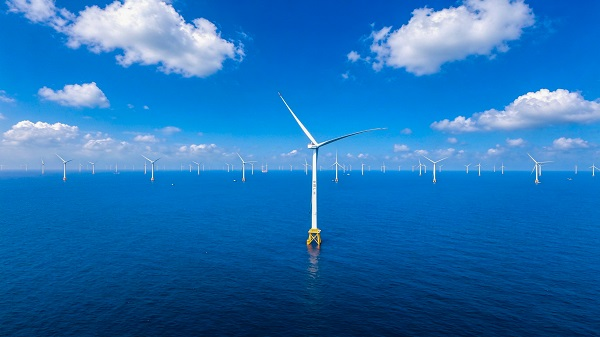
Operated by China General Nuclear Power Corporation, the Fanshi Offshore Wind Power Project has an installed capacity of 2 million kilowatts. [Photo/sasac.gov.cn]
The project, which is located some 81 kilometers offshore, has a total of 131 wind turbines, 33 of which are 18-MW ultra-large offshore wind turbines, making it the largest cluster of offshore wind turbines with such a high single-unit capacity deployed on a large scale.
The wind turbines have a rotor diameter of 292 meters, with a swept area of about 66,000 square meters, equivalent to the size of nine standard football fields, according to the company.
Under full-load operation, each rotation of the rotor can generate about 43 kilowatt-hours of electricity, enough to meet the daily electricity needs of an ordinary household for nine days. A single turbine can generate up to 56 million kWh per year.
Large-scale application can effectively reduce the number of turbine sites and lower the costs of submarine cable laying, offshore foundation construction, and sea area use, thereby reducing the offshore power generation costs.
The hoisting and installation of ultra-large equipment under deep-water conditions is widely recognized as a challenge for the wind power construction industry. The total weight of an 18-MW wind turbine during a complete-unit lift exceeds 1,500 metric tons. The installation of these bulky, heavy components is highly susceptible to wind conditions, which places stringent requirements on vessel operations, component attitude control and positioning and alignment accuracy.
To tackle multiple challenges, including long-distance heavy-load offshore transportation, component stability control under wind and wave conditions, and millimeter-level positioning accuracy, the project team made full use of the limited offshore work windows to successfully transport and install large components for the project. During this process, a set of construction solutions for installing ultra-large equipment under deep-water conditions were also developed, which can be replicated and applied to other projects.
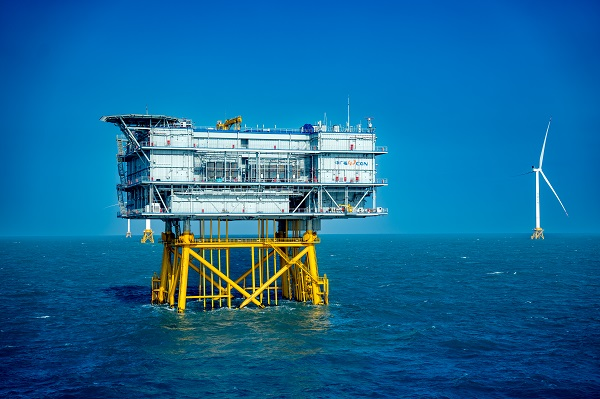
A view of the 500-kilovolt intermediate reactive power compensation station. [Photo/sasac.gov.cn]
The Fanshi Offshore Wind Power Project is a key component of Guangdong’s major infrastructure projects and a core part of the 10-gigawatt offshore wind power base in the province’s western region. It is home to China’s first 500-kilovolt intermediate reactive power compensation station located midway along an offshore wind farm’s power transmission route, pioneering a new grid connection model that enables large-capacity wind power to be stably transmitted over long distances and addressing longstanding industry challenges that have hindered the reliable grid integration of gigawatt-scale offshore wind farms.
Now fully operational, the Fanshi Offshore Wind Power Project can annually deliver more than 6.6 billion kWh of clean electricity to the grid, equivalent to saving about 1.92 million tons of standard coal and reducing carbon dioxide emissions by about 5.1 million tons. This is comparable to adding around 14,000 hectares of forestland.
The project will continuously optimize the energy mix of the Guangdong-Hong Kong-Macao Greater Bay Area and support Guangdong in building a clean, low-carbon, safe and efficient new power system. Since the project went into operation, Yangjiang’s installed offshore wind power capacity has surpassed 8 GW, making it the prefecture-level city with the largest installed offshore wind power capacity in China.
(Executive editor: Zuo Shihan)