In August 1934, the 6th Corps of the Red Army broke through the siege and marched in what are now Suxian and Beihu districts of Chenzhou City, South China’s Hunan Province. Following them, the main force of the Central Red Army passed through the regions and entered southern areas of the province.
Now, more than 90 years later, the rugged places where the Red Army arduously treaded are well connected with smooth roads. With accelerated industrial development and urban-rural construction, local power demand for production and livelihood keeps rising. To address this issue, the Hunan-Guangdong Power Interconnection Project has been proposed and its construction is in full swing.
The initiative is a crucial power planning project under China’s 14th Five-Year Plan (2021-25). Funded by State Grid Corporation of China and China Southern Power Grid Co., Ltd., it is expected to be operational in June 2027. It will enhance the cross-provincial power transmission capacity by 3 million kilowatts, meeting the peak demands of Hunan and Guangdong provinces.
At the center of the Hunan-Guangdong Converter Station is the valve hall and its eastern and western sides are almost symmetrically designed. The western, Hunan side will connect to the Sudan 500-kV Substation in Chenzhou via two 500-kV transmission lines, and the eastern, Guangdong side will link to the Danxia 500-kV Substation in Shaoguan, a city in Guangdong, with two 500-kV transmission lines.
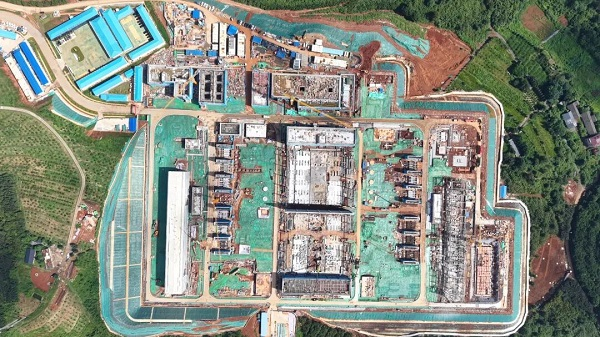
The construction site of the Hunan-Guangdong Converter Station. [Photo/sasac.gov.cn]
Hunan sees power consumption peaks in winter and summer, while Guangdong’s peak demand comes in summer, creating conditions for their two-way power support. Chenzhou, which connects Central China with South China, is hilly and thus has abundant small-scale hydropower resources. Once operational, the project will deliver Chenzhou’s clean electricity into Guangdong’s grid, turning the city into a regional power exchange hub.
The converter station sits on a hillside, with the southeast and southwest sides of its fill area equipped with a row of anti-slide piles to prevent soil erosion and stabilize the slope. The local stratum is dominated by dolomitic limestone with undulating surfaces dotted with clints and karst caves.
To tackle these challenges, some geological experts were invited to the project site. They tailor-made a kind of double-layered drill that has a large bit and a small bit. The project requires 200 piles, with the first 197 piles installed in over 70 days using the new drills, marking smooth construction progress.
A large area of the slope became exposed after construction. To restore vegetation, the project team mixed grass seeds, flower seeds and nutrient solution, and then sprayed it onto the slope through modified concrete jet machines. Within a month, the bare slopes would be covered with greenery.
From January to June, the construction period ran into the rainy season in southern Hunan. There were 119 rainy days, 79 of them with moderate or heavier rainfall. There were no consecutive sunny days. From the date of approval to that of operation, the converter station had a mere 19 months for construction, six months shorter than similar projects.
To tackle this problem, the project team adopted an air membrane structure supported by semi-circular air columns to form a large, all-weather and semi-enclosed working space. People and equipment can enter and exit it through a special arch. This allowed the construction work to proceed as usual, even during days with heavy rainfall.
The site preparation and pile foundation work for the converter station have now been completed, and 40 percent of civil construction has been finished. The critical hub supporting cross-regional energy transmission is steadily taking shape in the mountains once traversed by the Red Army.
(Executive editor: Zuo Shihan)