Nine compact intelligent welding robots nimbly moved on September 9 in the confined spaces between the plate units at the construction site of the steel girder for the main bridge of the Zhangjinggao Yangtze River Bridge. Their welding torches glided steadily, laying smooth and uniform welds amid flickering arc light.
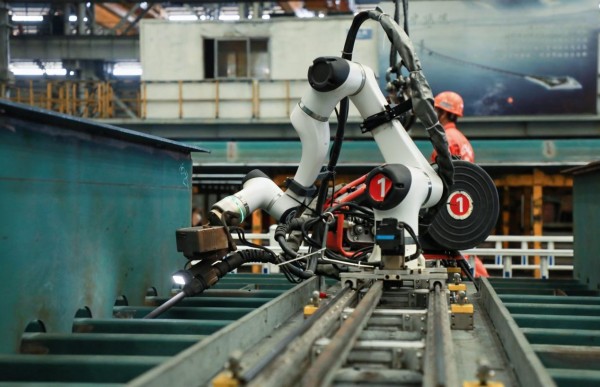
A view of robot welding. [Photo/sasac.gov.cn]
The robots — five portable vision-based intelligent welding robots and four mobile L-rib trough welding robots — were deployed by China Railway Shanhaiguan Bridge Group Co., Ltd. under China Railway Hi-Tech Industry Corp., Ltd., a subsidiary of China Railway Group Limited.
The main bridge is a steel box-girder suspension bridge with a main span of 2,300 meters. It is the world’s longest-span bridge under construction and marks China’s breakthrough in bridge span of over 2,000 meters. Upon completion, it will secure six world records and achieve six world firsts.
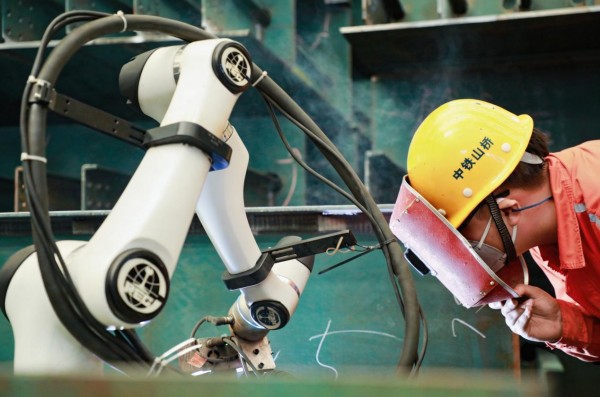
A view of robot welding. [Photo/sasac.gov.cn]
“It's difficult to weld in narrow L-rib troughs. Workers could barely get themselves into these areas, let alone guarantee welding quality,” said foreman Zhang Xinxing.
To address this challenge, Shanhaiguan Bridge Group employed the aforementioned two types of welding robots. Equipped with state-of-the-art technologies, such as teaching-free operation based on 3D vision and rack-driven servo motors, these little machines are fitted with “eyes” and “brains”, so that they can autonomously plan motion paths and perform precise welding under complex conditions.
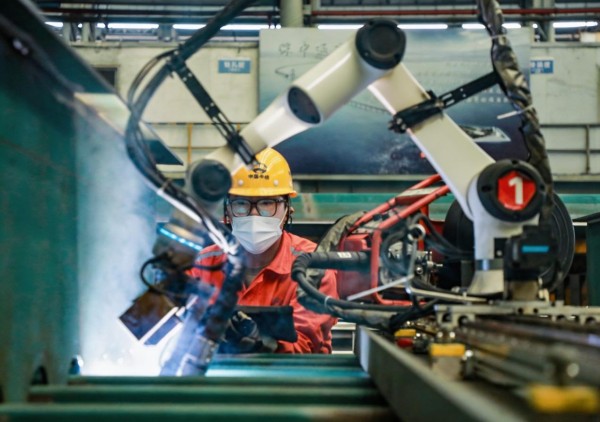
A view of robot welding. [Photo/sasac.gov.cn]
Portable robots are small and agile, and mobile robots are made to navigate trough structures. They cooperate with each other, successfully achieving automated welding in confined spaces.
Since the robots were put into operation, the overall welding efficiency has risen by 20 percent, the daily average output doubled from 10 to 20 metric tons and the product qualification rate increased by 10 percent. The average daily welding output of a single robot can reach 45.3 meters and 52.53 meters, respectively. To date, the robots have produced approximately 700 tons of qualified structural components.
Shanhaiguan Bridge Group has built a platform for workers to engage in innovation, enabling them to use their experience to guide technical upgrades. The company has also cultivated a cohort of versatile workers proficient in both equipment knowledge and operation.
(Executive editor: Zuo Shihan)