Construction of the joint inspection complex of the new Huanggang Port in Shenzhen, the world’s largest single-building land port structure, has entered its final stage.
The complex, built by China Construction Science and Industry Corp., Ltd. (CSCEC Science and Industry), a subsidiary of China State Construction Engineering Corporation, has a total floor area of nearly 700,000 square meters. Once completed, it will integrate passenger inspection and customs clearance, vehicle inspection, rail transit connections and public urban spaces.
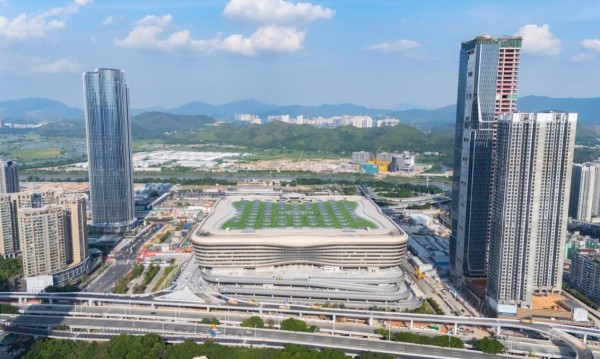
The new Huanggang Port will enhance the Shenzhen-Hong Kong connection and empower the high-quality development of the Guangdong-Hong Kong-Macao Greater Bay Area. [Photo/sasac.gov.cn]
The construction team of CSCEC Science and Industry leveraged advanced technologies and pursued collaborative technical solutions to address the daunting construction challenges, such as the exceptionally large and deep foundation pit, ultra-heavy steel structures and multiple overlapping vibration sources.
The team adopted a “layered excavation and step-by-step support removal” procedure while excavating the foundation pit that covers 79,500 square meters with a maximum depth of 27.5 meters, to ensure safety in the areas adjacent to metro lines and densely packed utility pipelines. For the first time in Chinese port construction, it employed a vibration isolation technology, reducing the vibration level of adjacent floors by 96.8 percent.
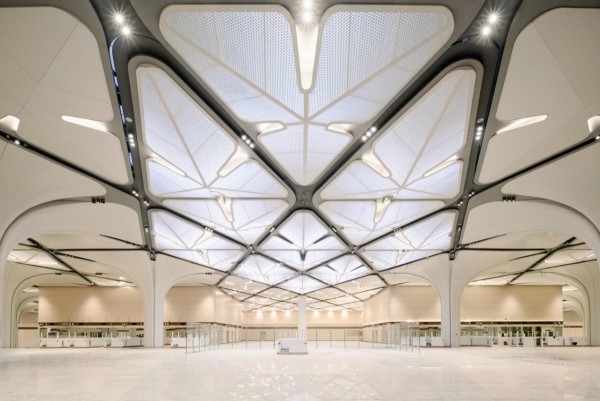
An interior view of the joint inspection complex. [Photo/sasac.gov.cn]
The joint inspection complex, which will be mainly supported by a steel structure, is expected to use 170,000 metric tons of steel, enough to build 23 Eiffel Towers. The construction team has deployed a robot fleet independently developed by China Construction Steel Structure Corp., Ltd., a subsidiary of CSCEC Science and Industry. They include eight flexible welding robots and two high-power laser rust-removal robots, enabling efficient and high-quality construction.
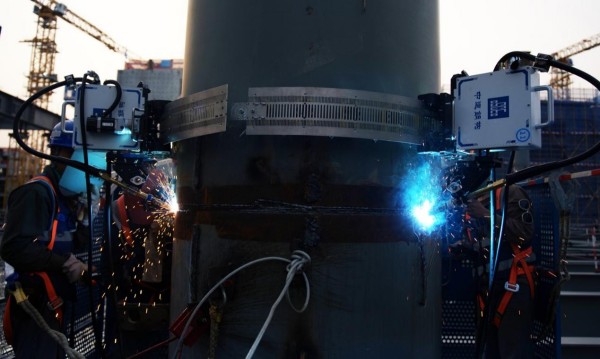
Flexible welding robots are in operation at the construction site. [Photo/sasac.gov.cn]
The complex comprises five above-ground and four underground floors. The first floor is designated for inbound vehicle inspection, and the third floor for outbound vehicles. The fourth and fifth floors house passenger entry and exit halls. The second underground floor is designed to provide direct access to five metro lines that respectively stretch to Shenzhen and Hong Kong.
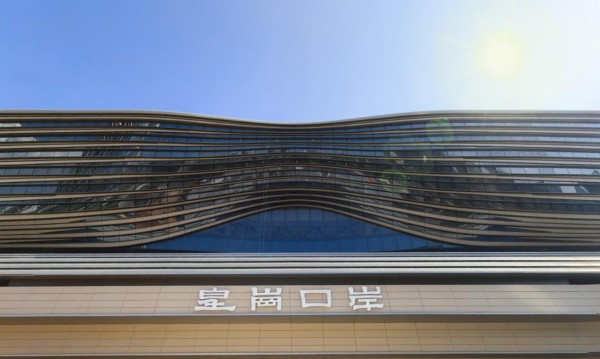
Passengers can reach the clearance hall once they leave the metro station. [Photo/sasac.gov.cn]
The new Huanggang Port, the only land port connecting Shenzhen and Hong Kong that runs around the clock, will employ the efficient clearance model of “joint inspection and one-stop clearance”, reducing clearance time to around 5 minutes from the current 30 minutes.
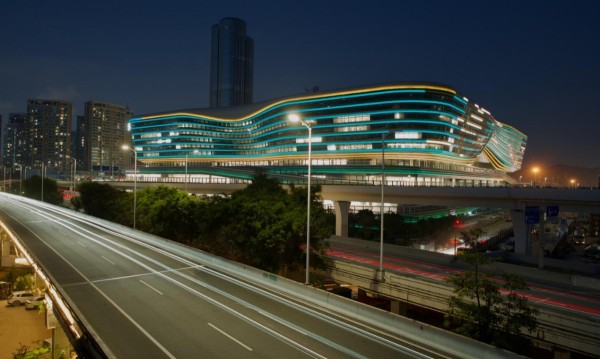
A night view of the joint inspection complex. [Photo/sasac.gov.cn]
(Executive editor: Zuo Shihan)