Construction work on the world’s first ultra-high voltage (UHV) project dedicated to nuclear power transmission is underway. Recently, the marine section of the 1,000-kilovolt Haiyang Xin’an nuclear power transmission UHV project entered the final stage of construction.
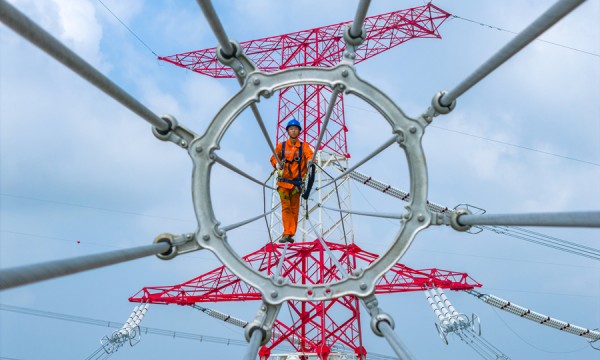
A staff member from Shandong-based subsidiary of State Grid Corporation of China is installing spacers for the power transmission line. [Photo/sasac.gov.cn]
The project, launched in June 2025 and scheduled for completion and operation in October 2026, is not only the world’s first UHV power transmission project tailored for nuclear power transmission, but also China’s inaugural UHV project with marine construction work.
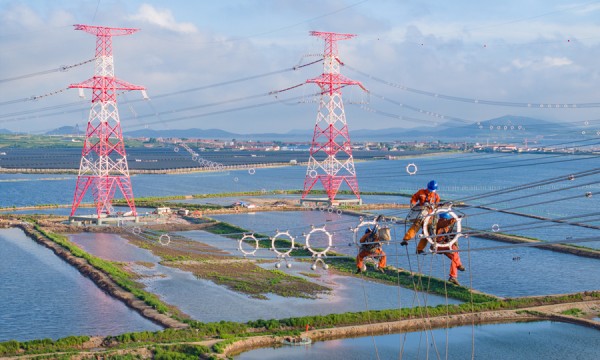
The project is China’s first UHV project involving marine construction work. [Photo/sasac.gov.cn]
The double-circuit transmission line is 80.361 kilometers long, stretching from Xin’an Town in Haiyang to Tuanwang Town in Laiyang, both of which are county-level cities under the administration of Yantai in Shandong Province. A total of 161 transmission towers will be built for the project, with 17 of them in the 11.2-km marine section.

Workers carry out the installation. [Photo/sasac.gov.cn]
The marine construction work of the UHV transmission line poses immense technical challenges, such as potential erosion caused by seawater and salt fog, the unique marine composite geological structure of soft topsoil and hard bedrock, as well as the volatile and complex coastal weather. The technical team has innovatively applied a number of cutting-edge technologies and developed a complete set of construction techniques, offering valuable practical experience for the development of China’s marine UHV projects.
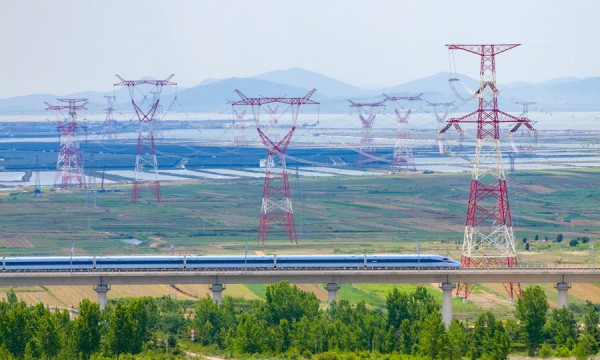
Power transmission towers stretch the line toward distant mountains. [Photo/sasac.gov.cn]
Upon completion, the project will be integrated into the Shandong power grid together with the 1,000-kilovolt Yantai-Weihai UHV project, forming China’s first provincial-level UHV double-ring grid. It will serve as a reliable power transmission channel for nuclear power stations on the Shandong Peninsula and the neighboring offshore new energy bases. The project is essential in optimizing the layout of Shandong’s UHV AC power grid, improving resource allocation within the province and facilitating energy transition and green, low-carbon development.
(Executive editor: Zuo Shihan)