On July 29, a freight train loaded with containers departed from Xiamen Ocean Gate Container Terminal of China COSCO Shipping Corporation Limited (COSCO SHIPPING), marking the opening of China’s first sea-rail intermodal line that is perpendicular to the shoreline and directly connected with the dock.
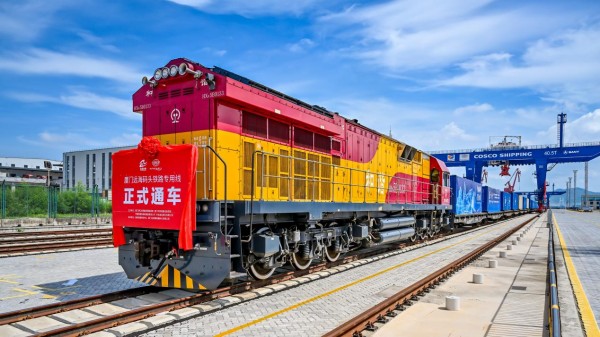
The dedicated railway line at Xiamen Ocean Gate Container Terminal. [Photo/sasac.gov.cn]
Trains Reach alongside Vessels
The 1,586-meter dedicated railway line is designed to handle an annual throughput of 250,000 twenty-foot equivalent units and 250,000 metric tons of bulk and general cargo. Differing from the traditional layout, the line runs perpendicular to the shoreline and extends deep into the core operation area of the dock, where goods can be directly loaded onto trains for transport.
Cost Reduction
Traditional sea-rail intermodal transport has a three-stage transit model of “train-yard-vessel”. Previously, cargo at Xiamen Ocean Gate Container Terminal had to be transported to a railway yard 20 kilometers away, incurring additional expenses for trailers and secondary lifting.
The new railway line directly accesses the port, eliminating intermediate transit links and associated costs. It’s estimated that the new line will cut the overall logistics cost by more than 15 percent and shave 2 to 3 days off the overall logistics cycle.
Higher Efficiency
Xiamen Ocean Gate Container Terminal is China’s first fully automated container terminal with advanced automated equipment. The dedicated line is equipped with four railway gantry cranes and a customized railway system module. In this way, the terminal system can directly access railway information data, enabling integrated and automated operation of the terminal and railway. This creates a new operation mode — cargo can be transferred within 9 minutes and the entire transfer process occurs in a short section of merely 70 meters, thereby significantly improving the quality and efficiency of sea-rail intermodal transport.
Expanded Logistics Network
Xiamen Ocean Gate Container Terminal operates 21 ocean trunk routes that cover Europe, America, Australia, the Middle East and Southeast Asia. The terminal’s new railway line enables two-way connectivity between Xiamen Port’s maritime network and a comprehensive railway network that extends to China’s inland regions including Jiangxi, Hubei and Sichuan.
In the first half of 2026, Xiamen Port’s sea-rail intermodal transport volume surged by 35.76 percent year-on-year. The launch of the dedicated railway line will further expand the port’s cargo source from the Minnan Golden Triangle to more inland areas such as Jiangxi, Hunan, Hubei and eastern Guangdong.
Multi-Party Collaboration
To maximize the operational efficiency of the railway line, the port, railway and customs authorities have established extensive collaborative procedures. The port and railway communicate with each other on operation plans in advance, coordinate scheduling and share equipment, transforming the previous segmented port-rail operation into integrated management.
The railway line has been authorized with a one-stop customs clearance model – it requires only one declaration, one inspection and one release. The customs authority has launched an innovative “dynamic checkpoint” supervision mode, which can automatically verify and clear trains, so those passing through port checkpoints don’t have to wait.
The dedicated railway line at Xiamen Ocean Gate Container Terminal applies China’s pioneering port-rail linkage layout and represents another benchmark set by COSCO SHIPPING through its continuous innovation in multimodal transport and in-depth development of smart ports.
Moving forward, the corporation will take Xiamen Ocean Gate Container Terminal as a pivot to connect maritime trunk routes and inland railway corridors, upgrading the logistics network via linking routes with key hubs and expanding coverage through route networks.
(Executive editor: Zuo Shihan)