At 8 pm on July 23, a Long March 3B carrier rocket lifted off from the Xichang Satellite Launch Center in Southwest China’s Sichuan Province to place the Tianlian II-06 satellite into its pre-designated orbit. The launch mission was a complete success.
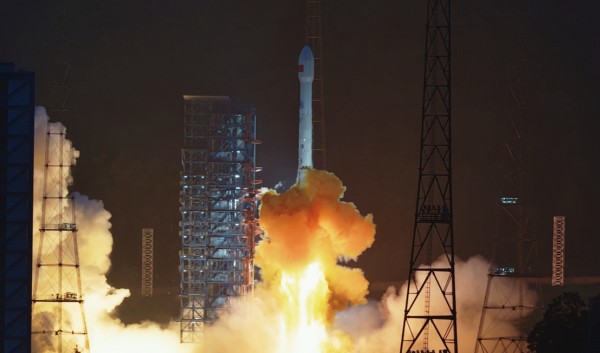
The Long March 3B carrier rocket blasts off. [Photo/sasac.gov.cn]
The Tianlian II-06 satellite, developed by China Academy of Space Technology, a subsidiary of China Aerospace Science and Technology Corporation (CASC), is China’s second-generation geostationary orbit data relay satellite. It mainly provides data relay and telemetry services to medium- and low-orbit Earth resource satellites and manned spacecraft, such as crewed spaceships and the Tiangong space station. It also provides telemetry services for spacecraft launch campaigns.
Since the launch of the Tianlian II-01 satellite in 2019, the R&D team has continuously optimized the full-cycle satellite development process and advanced the mass production of satellites in phases. It took the team three years to develop the Tianlian II-02 and II-03 satellites, while the development of Tianlian II-04, II-05 and II-06 satellites only took two years, meaning that the development cycle of a single satellite was much shorter. The six Tianlian II satellites have been launched one after another to form a complete space network, steadily expanding the coverage and increasing the efficiency of China’s new-generation space-based data relay services.
The Long March 3B rocket is developed by the China Academy of Launch Vehicle Technology, a subsidiary of CASC, on the basis of the Long March 3A rocket. Since 2019, the Long March 3B rockets have consecutively completed all six launch missions for Tianlian II-01 to II-06 satellites.
This latest mission marked the 658th flight of the entire Long March carrier rocket family.
(Executive editor: Zuo Shihan)