In this first year of the 15th Five-Year Plan (2026-30) period, construction of several major Chinese oil and gas infrastructure projects has accelerated. Work on key trunk pipelines and gas storage and peak shaving facilities is progressing steadily, further densifying the national oil and gas transmission network. This increasingly interconnected network lays a solid foundation for building China into an energy powerhouse.
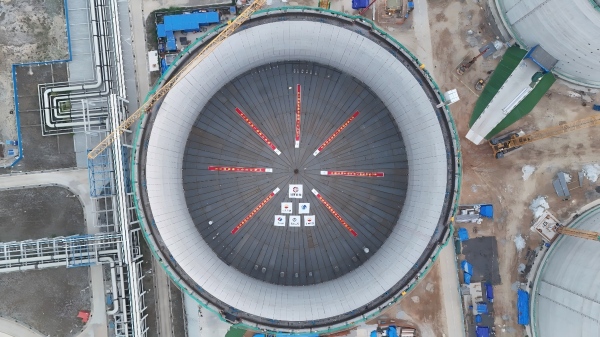
The Hainan liquefied natural gas (LNG) phase II project in Danzhou, South China’s Hainan Province. [Photo/sasac.gov.cn]
China Oil & Gas Pipeline Network Corp (PipeChina) recently completed the air-jack dome lifting for the No.3 storage tank of the Hainan liquefied natural gas (LNG) phase II project in Danzhou, South China’s Hainan Province.
The storage tank has a capacity of 220,000 cubic meters. Its dome weighs 821 metric tons and is lifted to a height of approximately 43 meters, equal to a 15-story building. The lifting provides a solid foundation for the Hainan Free Trade Port to become an LNG supply hub for ASEAN and a storage and trans-shipment hub in the Asia-Pacific.
Currently, the phase II project is nearly 50 percent complete and is expected to be fully operational in 2027. Upon completion, it will add 400 million cubic meters of gas storage capacity, significantly enhancing regional peak shaving and supply security.
Construction of the Jiangsu-Anhui-Henan Trunk Line, the Wen 23-Anqing Natural Gas Pipeline and the Northern Trunk Line of the Shandong Provincial Pipeline Network, all launched in 2026, is now fully underway. Meanwhile, construction of the Second Sichuan-to-East Gas Transmission Pipeline, a major project under the 15th Five-Year Plan, is accelerating. Tunneling and pipeline welding are being carried out simultaneously, with 1,000 kilometers planned to be welded this year.
In Changchun, the capital of Northeast China’s Jilin Province, construction of the Changchun Connecting Compressor Station for the Hulin-Changchun Natural Gas Pipeline Project was completed with the final weld joint passing inspection, achieving interconnectivity among the Harbin-Shenyang Pipeline, the Changchun-Jilin Pipeline and the Hulin-Changchun Pipeline.
Construction of the nine stations along the Hulin-Changchun Pipeline is now largely complete, with the overall project more than 90 percent finished. The pipeline is expected to be fully operational by the end of 2026.
The main trunk line of the coal-to-natural gas project in the Zhundong Economic and Technical Development Zone, Northwest China’s Xinjiang Uygur Autonomous Region, which serves as the outbound pipeline for China’s largest coal-to-gas production base, has completed 118 kilometers of welding. Once operational, the pipeline will interconnect with China’s West-East Gas Pipeline system, enhancing China’s natural gas supply security.
The Lianyungang-Huai’an section of the crude oil pipeline connecting the city of Lianyungang and Yizheng County, both in East China’s Jiangsu Province, has completed over 99 percent of its welding work. Construction of the two stations and six valve chambers is progressing smoothly. The section is expected to begin operations by the end of June. Upon operation, it will enhance the stability and security of crude oil supply to Nanjing, the capital of Jiangsu, and other regions along the Yangtze River.
PipeChina is currently constructing nearly 40 major oil and gas pipelines, with a total length of over 9,000 kilometers.
(Executive editor: Zuo Shihan)