The natural gas storage expansion project beside the Tuz Golu, a salt lake in central Turkiye, is an overseas project of Power Construction Corporation of China (POWERCHINA).
As a landmark project launched by China and Turkiye following the signing of a memorandum of understanding to align the Belt and Road Initiative with Turkiye's “Middle Corridor” strategy, it plays a significant role in Turkiye's energy development strategy. It will enhance the country’s storage capacity, reducing its dependence on imported energy and meeting the needs of people’s daily lives and industrial prosperity.
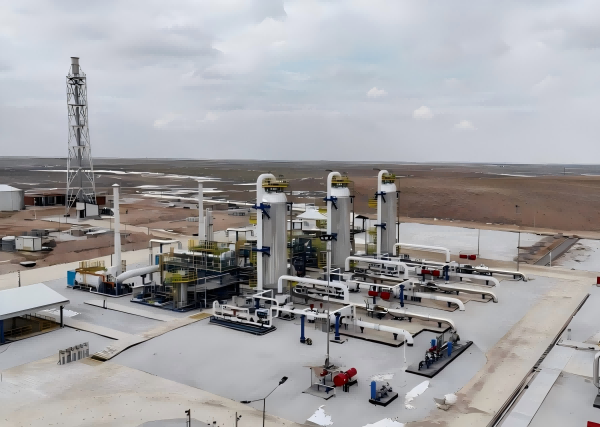
The natural gas storage expansion project is beside the Tuz Golu, a salt lake in central Turkiye. [Photo/sasac.gov.cn]
“In the future, I want to act as a small ‘bridge’ that connects Turkiye and China,” said Turkish translator Lin Aijia (her Chinese name) in her graduation speech. In 2019, she and more than 200 Turkish employees joined POWERCHINA, and at that time, she believed that translation is just a linguistic technique, simple and straightforward.
However, the reality reminded her of the difficulty in serving as a “bridge” between two cultures.
During the construction of the second phase of the project, Turkish workers took a tea break twice a day, at 10 am and 3 pm. This seemed odd to Chinese engineer surnamed Zhang as those rest periods came right in the middle of the work. At the same time, Turkish engineer Ibrahim was puzzled by his Chinese counterparts, who remained working and took no break.
The two sets of work ethics collided with each other. Lin, as the translator, chose not to just convey a simple message, but to make a cultural explanation — the Turkish tea break is a work custom that is meant to enhance concentration by allowing a short period of relaxation, while the Chinese-style approach emphasizes finishing work in a single go.
After the explanation, both sides understood their co-workers. Zhang would sip a cup of tea while enjoying talks, and he found that he had a clearer mind after that. Ibrahim would stay at his post during crucial periods to better follow the pace of the Chinese workers. Neither philosophy dominated the other, but instead they co-existed.
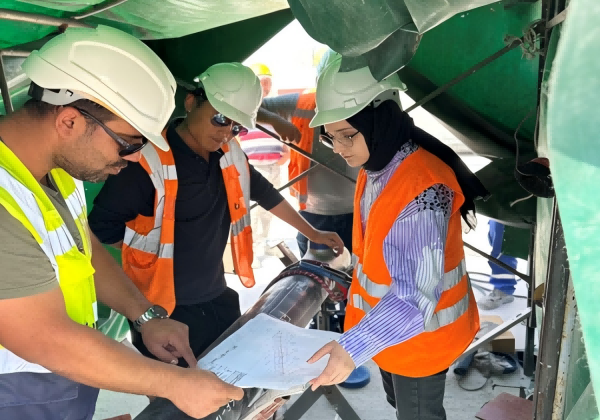
Turkish translator Lin Aijia performs an on-site translation. [Photo/sasac.gov.cn]
As the construction advanced, a new requirement emerged from the client: each batch of welding rods had to be colored after baking and those that were not reusable should be brushed red. Lin felt uneasy about that, because she knew that the different regulations would cause confrontation.
Zhang, however, felt no discomfort. He walked in with two cups of tea in his hands.
“Could you please bring the client here so that we can discuss matters over tea?” he said, smiling.
Lin was astonished. She had seen many fierce negotiations, but this was her first time seeing negotiations with tea.
The poker-faced client was led in.
“What a cold day. Please have some tea,” said Zhang, pushing a cup toward him.
Attracted by the fragrance, the client started to drink. The warm tea eased his stiff posture. That was when Zhang scrolled out the engineering drawing, which specified how rods should be colored.
“We understand the traceability you want. But to color the welding rods after baking is not as good as getting them on demand and record the whole process of use,” said Zhang, as though he were making small talk.
“We can color them. But the work quality and efficiency will be higher if we start our supervision at the beginning,” Zhang added.
The client lowered his head to take a glimpse at the drawing and shifted his gaze to the cup of tea in his hand. His expression relaxed. He asked Zhang a technical question, and Zhang patiently answered while refilling the client’s cup. They conversed like a pair of long-term cooperation partners.
Finally, the client raised his cup and nodded. That was how things settled.
“Why didn’t you just argue with him?” Lin asked after the meeting.
“Even if we win the argument, we would lose his trust. Our work is to complete construction, instead of engaging in argument,” Zhang laughed. “We can make his standards clear and finish work in our own way. Treat him to a cup of tea, and everything is no problem.”
Suddenly, Lin understood that “Chinese standards in light of local conditions” does not mean rigid adherence to a script or the stubborn application of Chinese methods. Instead, it involves engaging in dialogue with others while respecting international norms.
From that day on, she started to understand her roles in a new light, not just as a translator, but as a person who can guide both sides to understand each other’s opinions.
During the two years of building the second phase of the project, the construction team carefully and responsibly finished work that could stand the test of time. The project not only stored natural gas, but also provided hundreds of jobs for local Turkish people. More and more local workers became experienced in operating Chinese devices and could understand complicated drawings.
“Trust cannot be a result of dispute, nor a stipulation outlined in the contract. Trust lies in every weld, every cup of tea, and every pair of hands of Turkish workers who transformed from inexperienced to proficient,” said Ibrahim. The transformation he underwent is that he went from being a skeptic of the Chinese work style to the backbone of the project.
The construction team has also won the bid for the third phase of the project.
When implementing the Belt and Road Initiative, a sincere attitude and advanced technologies are the key to achieving mutual recognition among cooperation partners. The natural gas of the Tuz Golu will power up Turkiye, while the trust of Turkish partners will provide a big boost for Chinese techniques and wisdom.
(Executive editor: Zuo Shihan)