On April 24, the 11th Space Day of China, the China National Space Administration published the latest research results on the lunar samples retrieved in the Chang’e-5 mission.
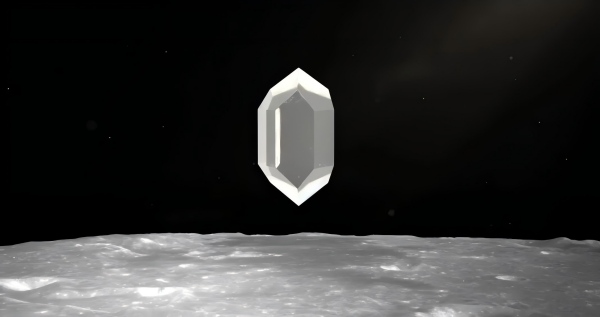
The ideal crystal structure of Magnesiochangesite-(Y). [Photo/sasac.gov.cn]
Chinese scientists have identified two previously unknown lunar minerals from the samples. They have been reviewed and approved by the International Mineralogical Association’s Commission on New Minerals, Nomenclature and Classification, the global authority responsible for verifying and naming newly discovered minerals, and have been named Magnesiochangesite-(Y) and Changesite-(Ce).
The discovery of Magnesiochangesite-(Y) is a major breakthrough made by a research team consisting of members from the Beijing Research Institute of Uranium Geology (BRIUG), a subsidiary of China National Nuclear Corporation, the National Astronomical Observatories of the Chinese Academy of Sciences and the Jiangxi Institute of Applied Science and Technology. In 2022, the team discovered Changesite-(Y), which was the first lunar mineral found by Chinese scientists.
Magnesiochangesite-(Y) is the second lunar mineral discovered by Chinese scientists and the seventh ever found by scientists around the world in returned lunar samples. The Chang’e-5 spacecraft retrieved basalt fragments from the moon and brought them back to Earth, from which the samples had been extracted. The newly found lunar mineral has no identical counterpart found on Earth.
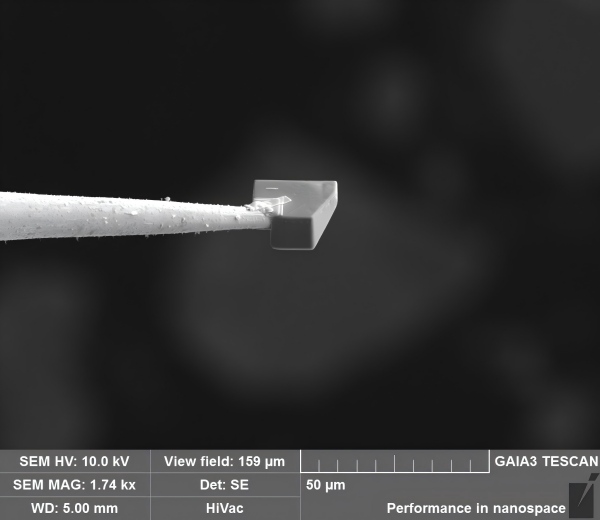
A nanorobotic hand extracts a single crystal particle of the Magnesiochangesite-(Y) mineral. [Photo/sasac.gov.cn]
Magnesiochangesite-(Y) and the previously discovered Changesite-(Y) both belong to the merrillite group.
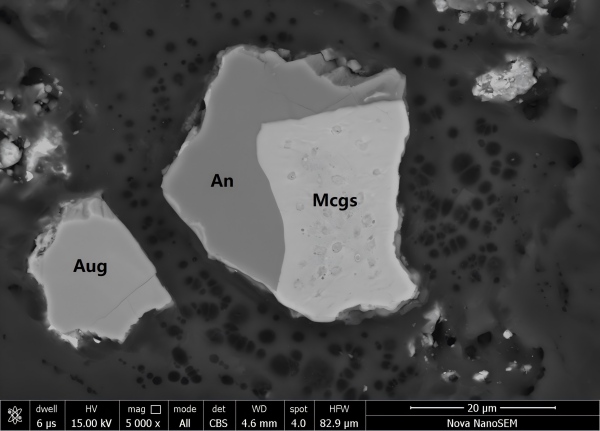
A backscattered electron image of Magnesiochangesite-(Y). [Photo/sasac.gov.cn]
The discovery of new lunar minerals provides crucial evidence for the research into the moon's composition, geological evolution and origin, which can further people’s understanding not only of this celestial body but also of the universe.
Under the country’s innovation-driven development strategy and driven by the endeavors to promote the innovation of basic sciences, the research team has discovered two lunar minerals within four years. The BRIUG has long leveraged its advantages to study lunar samples and has set up the research team with other academic facilities to overcome technical issues, thereby contributing to China’s exploration of the moon and deep space.
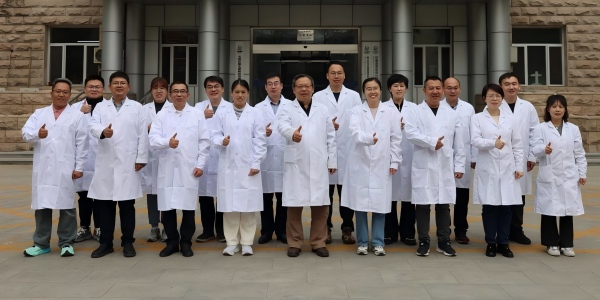
Part of the research team poses for a group photo. [Photo/sasac.gov.cn]
Going forward, CNNC will continue to leverage technical advantages to strengthen studies of lunar samples and deep-space exploration, in a bid to produce more original and pioneering scientific achievements, to build China into a leading power in space and science and technology, and to promote the high-quality development of China’s deep-space exploration.
(Executive editor: Zuo Shihan)