The outline of China’s 15th Five-Year Plan (2026-30) emphasizes the exploration of the deep sea and strata as well as the polar regions, giving rise to a series of frontier research initiatives.
China National Offshore Oil Corporation (CNOOC) is advancing its exploration in ultra-deep waters and ultra-deep strata.
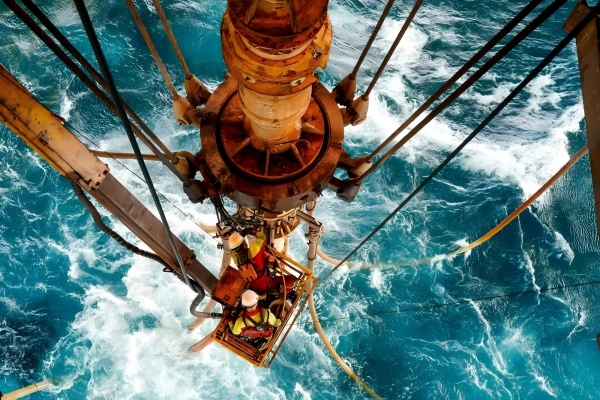
The drilling of the first deep-water, high-pressure development well of China National Offshore Oil Corporation is completed. [Photo/sasac.gov.cn]
Ultra-deep waters refer to waters deeper than 1,500 meters and ultra-deep strata refer to formations buried at depths of over 4,500 meters. The exploration of these areas demands great technological capabilities and extensive project support, in which CNOOC has already built substantial expertise.
During the 14th Five-Year Plan (2021-25) period, the number of deep-layer drilling operations conducted by CNOOC has increased fourfold, with the vertically deepest one extending more than 5,000 meters. China has since become the third country in the world, after the United States and Norway, that is capable of developing deep-water oil and gas independently.
Over the past five years, many oil fields with reserves of 100 million metric tons and gas fields with reserves of 100 billion cubic meters have been found in complicated areas, such as buried hills, deep waters and deep strata.
“Currently, CNOOC has fully entered the era of exploring deep and ultra-deep strata, and it will continue to advance exploration in ultra-deep waters,” said Lai Weicheng, chief geologist at CNOOC’s General Research Institute.
During the 14th Five-Year Plan period, CNOOC significantly increased the success rate of offshore exploration in deep strata, constantly catching up with the average success rate of offshore exploration in shallow strata. The hard-won leap is attributed to the advances made in oil and gas exploration in both theory and technology.
China’s deep-water structures that bear oil and gas have natural disadvantages compared to those of other countries.
“The thickness of the oil and gas reservoirs is very different. The reservoirs as thick as dozens of meters are considered good ones in China,” said Wang Jianhua, chief geophysicist at the Exploration and Development Institute of CNOOC’s General Research Institute.
Wang said that the exploration will be much more difficult if conducted in deep strata, owing to their unique features.
“Therefore, we have to boldly advance in exploration theory and technology,” she said. “It was unimaginable in the past that a large gas field would be buried hundreds of meters beneath the seabed. This is just like a gas reserve lying in plain sight, which is unprecedented worldwide.”
In 2024, CNOOC discovered Lingshui 36-1, the world’s first gas field with a reserve of 100 billion cubic meters that lies in the ultra-shallow stratum in the ultra-deep sea. The discovery once again expanded knowledge related to the gas and oil exploration in ultra-deep waters.
CNOOC has sped up the process from exploration to development in recent years. For instance, during the discovery of the Bozhong 26-6 oilfield, development was initiated immediately after exploratory wells confirmed initial hydrocarbon potential. This enabled a model of developing the core area while continuing exploration and reserve expansion on the periphery. To date, the company has launched the second-phase development of the oilfield, which is proven to have more than 200 million cubic meters of reserves.
During the 15th Five-Year Plan period, exploration and development in deep waters and deep strata will remain a challenge. The exploration in deep waters and deep strata requires the capability of seeing the formations and especially seeing them clearly. According to the exploration team, they need to have a clear visual of the strata, which demands more advanced seismograph equipment and imaging technology.
“Going to space is easier than going underground. Compared with the imaging of the Earth’s deep interior, we even think it’s easier to make an image of the surface of Mars,” said Wang.
She is not joking. The deeper the strata, the harder it is to acquire seismic data and create a clear image.
“Factors, including rugged seabeds, energy absorption by geological formations and complex faults, weaken the signals of seismic waves reflected from deep layers, making conventional imaging techniques ineffective,” she said.
In recent years, CNOOC has accelerated independent R&D of geophysical equipment. The Haijing system, China’s independently developed marine seismograph equipment, has so far completed 3D seismic data acquisition in an area of 6,552 square kilometers. The system, installed on deep-water geophysical survey vessels, can penetrate to the strata lying nearly 10,000 meters beneath the sea surface, and its core components are all developed by China.
However, high-precision imaging of deeper strata demands more advanced equipment, Wang said. The ultimate goal is to build comprehensive exploration capabilities for ultra-deep waters, ultra-deep strata, ultra-high temperature and ultra-high pressure environments, thereby strengthening the resource foundation for stable offshore oil and gas production.
With the advancement of offshore oil and gas exploration into deeper formations and the development of seismic exploration technology, both the volume of seismic data and computational cycles have grown exponentially. For instance, the seismic data of an 800-square-kilometer offshore area increased from 36 TB to 300 TB during data processing.
“Such a large data volume places extremely high demands on software algorithms, computing power and storage resources,” said Wang. “With more efficient algorithms and better computing clusters, we could significantly reduce the data processing time and improve the imaging quality.”
During the 15th Five-Year Plan period, CNOOC will conduct a second round of 3D seismic data collection. It is imperative to develop new technologies and equipment to deal with the massive data that goes through annual reprocessing or is newly acquired. Only in this way can we get clear images of the conditions in ultra-deep waters and ultra-deep strata and address subsequent challenges.
Each advance in technological breakthroughs, theoretical innovation, the independent development of equipment and the enhancement of computing will help build China into a marine powerhouse and protect China’s energy security.
(Executive editor: Zuo Shihan)