After the New Year holiday, as people returned to work and school, Zhai Lixin, a Chinese stationmaster on the Lagos-Ibadan Railway in Nigeria, received a video call from his son. Zhai once again enthusiastically shared stories about the railway. His son had been listening to such stories with keen interest since childhood.
“Your dad logged ‘six million’ last year,” Zhai said to his son over the phone, “Can you guess what that means?”
His son jokingly asked if he had struck it rich. But the “six million” actually referred to the number of steps Zhai had taken the previous year while inspecting the railway line. Converted into distance, those steps added up to thirty times the length of the main line of the Lagos-Ibadan Railway.
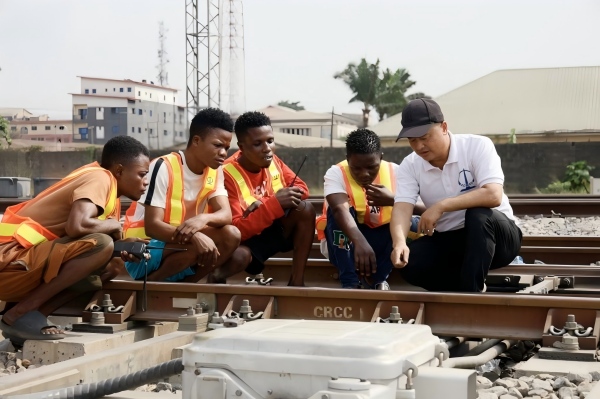
Zhai Lixin conducts on-site training on switch machines for Nigerian staff members. [Photo/sasac.gov.cn]
The railway, constructed and operated by China Civil Engineering Construction Corporation (CCECC), links Lagos, Africa’s largest city, with Ibadan, a major industrial hub in Nigeria. Built entirely according to Chinese railway standards, it is the longest double-track standard-gauge railway in Africa to date.
Zhai considers it a great honor to work as the stationmaster of the Lagos Station. To ensure safe and orderly train operations, he leads local workers to inspect station signals, switch equipment and rolling stock on foot every day. It has become a routine that continues even on holidays. Yet in his brief free time after work in the evening, Zhai, never one to sit idle, would pick up his carving knife.
A graduate of an art school, Zhai has always loved engraving. Last year, hoping to communicate more efficiently with local workers, he started memorizing English words during breaks while carving wood. Today, some of his recorded English instructions are preserved on the servers of the Nigerian Railway Corporation as teaching materials.
In recent years, the Lagos-Ibadan Railway has launched container freight services. The Lagos light rail, Red Line, which runs parallel to the railway, has commenced operations. ENL Consortium Limited, a Nigerian company providing cargo handling, haulage and logistics, also started bulk cargo transport thanks to the railway.
As the complexity of station operations has increased, Zhai became concerned about the inadequate technical skills of the local workers. To tackle this challenge, he led local employees in creating hundreds of instruction cards detailing work procedures. This established a training model of "experienced workers mentoring newcomers" and "issuing instructions based on card guidance," enabling local workers to learn on the job. This approach significantly improved their technical proficiency. Zhai himself was honored with the title of "Most Popular Instructor" by Nigerian trainees.
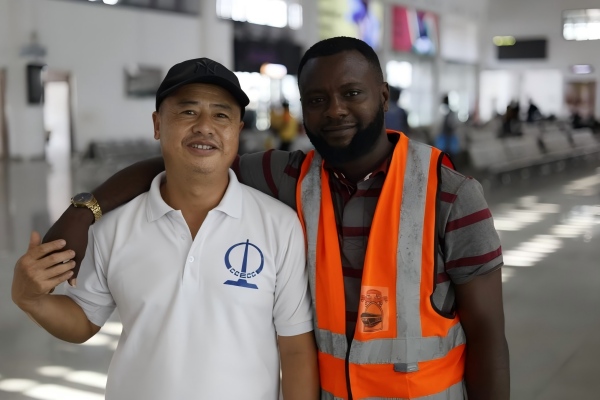
Zhai Lixin takes a picture with a Nigerian staff member. [Photo/sasac.gov.cn]
Stirred by the agricultural passion ingrained in the Chinese spirit, Zhai came up with the idea of raising pigs together with the local workers. A few diligent workers even started raising pigs at home. They told Zhai that for next Christmas, they too would butcher their own pigs for the feast.
"Fifteen years have passed. Time flies so fast," Zhai said. Over the years, he has taken only one Spring Festival holiday. He missed his son’s college entrance exam, his postgraduate entrance exam, and almost all year-end family reunions. Yet he has not missed a single important moment in Nigeria’s railway modernization.
When he was a child, Zhai once stood in the goose-feather-like snow of his hometown, the city of Qitaihe, in Northeast China’s Heilongjiang Province, watching the diesel locomotive of the Tumen-Jiamusi Railway rush past his doorstep. Back then, he never imagined that he, too, would forge a lifelong bond with the railways.
Zhai Lixin’s stories mirror the lives of countless Chinese builders working overseas. Their ordinary yet moving stories, together with China’s achievements in overseas projects along the Belt and Road, are forging a bright blueprint of mutual development, connected hearts, and the shared future of humanity.
(Executive editor: Zuo Shihan)