The world’s largest pile-driving vessel, the Tie Jian Da Qiao Zhuang 1, was recently launched in Nantong City, in East China's Jiangsu Province.
The vessel, independently invested in and built by China Railway Construction Bridge Engineering Bureau Group Co., Ltd., a subsidiary of China Railway Construction Corporation Limited, will be used to construct major infrastructure projects, such as far‑sea engineering, cross-sea bridges, and offshore wind farms.
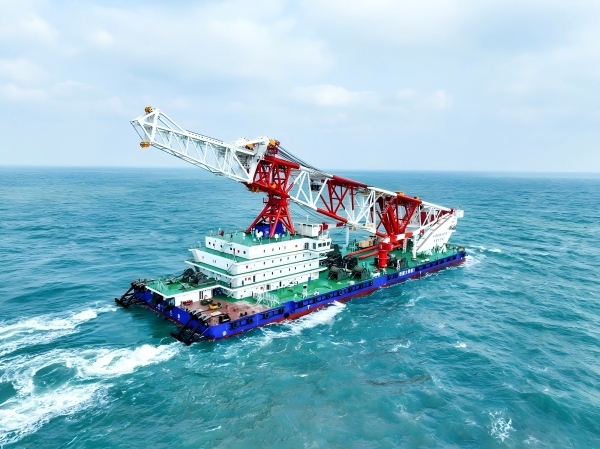
Tie Jian Da Qiao Zhuang 1, the world’s largest pile-driving vessel, begins sea trials. [Photo/sasac.gov.cn]
The vessel is 130.5 meters long and 40.8 meters wide and has an 8.4-meter molded depth. The pile-driving frame mounted on the ship stands 156 meters tall. It is capable of driving piles up to 7 meters in diameter and weighing 700 metric tons, at a water depth of up to 70 meters, with positioning accuracy at the centimeter level. The vessel currently leads the world in terms of pile-driving frame height, lifting capacity and operational water depth.
The ship employs two globally pioneering technological innovations. The integrated technology of dynamic positioning and mooring positioning enables the vessel to monitor wind, waves, currents, and hull attitude in real time. Through this, the vessel can automatically adjust thrust to maintain balance, significantly enhancing construction efficiency and safety in complicated marine conditions.
The vessel also adopts a closed-loop hydraulic system for the main cylinder, achieving an energy recovery rate of 40 percent. The system can smartly switch between consumption and regeneration modes in accordance with actual pile-driving loads, significantly reducing energy use and operational costs.
The vessel also has an exhaust-gas treatment system that complies with the highest international standards, thereby meeting the emission requirements in all sea areas around the world.
Each of the vessel’s core components was independently developed by China. The R&D team made technical breakthroughs in ultra-long component processing and high-precision control, ensuring that the straightness error of the 24.6-meter piston rod remains within 0.2 millimeters, a performance better than that of exported rods.
The vessel outperforms its international mainstream counterparts in various aspects, such as pile‑frame height, operational capability, intelligent systems, and environmental sustainability. This underscores China’s leading position in global pile-driving vessel technology.
Upon delivery, the vessel will sail to Brazil to participate in the construction of the Salvador-Itaparica Bridge, which will be Latin America’s largest cable-stayed sea-crossing bridge. This project stands as another landmark example of China’s high-end marine engineering equipment serving global infrastructure development.
(Executive editor: Zuo Shihan)