The L Site wind farm in the sea area north of the Shandong Peninsula, China’s deepest offshore wind power project, achieved full-capacity connection to the grid on April 7.
The wind farm, constructed by China Huaneng Group Co., Ltd. (China Huaneng), marks a breakthrough in the country’s offshore wind sector. It demonstrates advanced capabilities in complicated marine circumstances, integration of multiple large-capacity turbine units, and high-precision intelligent construction.
China Huaneng’s Shandong branch invested in and built the wind farm, and it is managed by a power plant owned by the company in Yantai. The wind farm has 42 sets of 12-megawatt turbines and a total installed capacity of 504,000 kilowatts.
The wind farm is located about 70 kilometers offshore, where water depths range from 52 to 56 meters, making it China’s deepest commercial offshore wind farm in operation. It can generate about 1.7 billion kilowatt-hours of electricity annually, saving nearly 500,000 metric tons of standard coal.
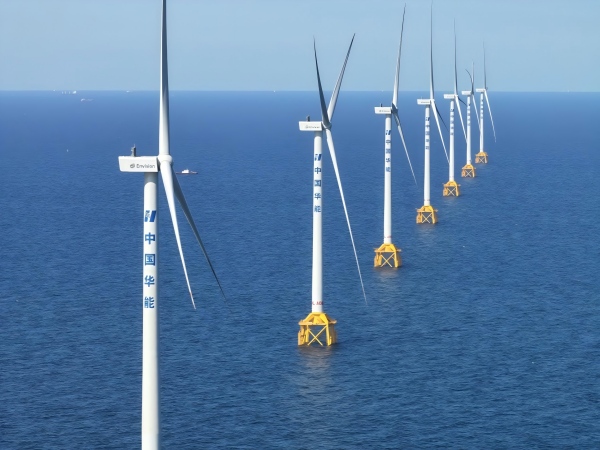
China Huaneng’s L Site wind farm in the sea area north of the Shandong Peninsula attains full-capacity connection with the grid on April 7, 2026. [Photo/sasac.gov.cn]
The project overcame a series of difficulties, including complex geology in far‑shore waters, frequent extreme marine conditions and ultra-long-distance construction operations. The wind farm employs a four-pile jacket foundation structure with a maximum height of 83.9 meters, the tallest of its kind in China. It ensures the safe and stable operation of turbines in deep-sea complex geological environments.
With the help of the Beidou Navigation Satellite System, the project developed high-precision positioning technology that enabled millimeter-accurate positioning for pile sinking on the seabed, reducing the time required to sink a pile from 48 to 29 hours.
Furthermore, leveraging coordinated drone and artificial magnetic field technology, the construction team accomplished the laying of an ultra-long submarine cable stretching 95.6 kilometers.
(Executive editor: Zuo Shihan)