The first turbine of the Sanshandao VI offshore wind farm, a project of China Huadian Corporation, Ltd., in Yangjiang, South China’s Guangdong Province, was installed on April 9.
China Energy Engineering Group Guangdong Electric Power Design Institute Co., Ltd. (GEDI), a subsidiary of China Energy Engineering Group Co., Ltd., is responsible for the wind farm’s engineering, procurement and construction. The installation marked the start of the full-scale construction of China’s farthest offshore wind farm.
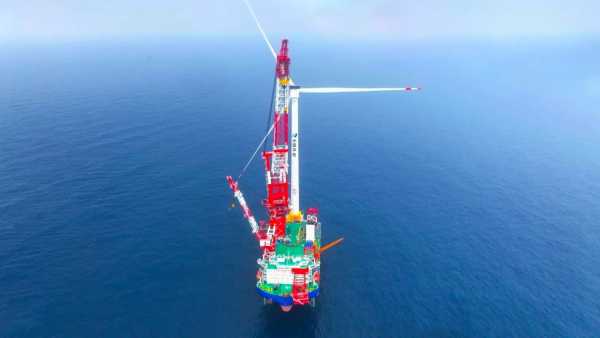
The construction team installs the first turbine’s jacket structure. [Photo/sasac.gov.cn]
The wind farm is located south of Hailing Island in Yangjiang, in an area with a water depth of 46 to 50 meters. The wind farm’s center is 82 kilometers from shore and its farthest tip is 89 kilometers away. With an installed capacity of 500 megawatts, the wind farm is designed to comprise 31 16.2-MW turbines.
Once completed, the wind farm is expected to produce about 1.6 billion kilowatt-hours of clean electricity, meeting the annual needs of nearly 700,000 households. Such a large amount of clean power generation is equivalent to the reduction of more than 500,000 metric tons of standard coal and the cutting of 1.26 million tons of carbon dioxide emissions. In this way, the wind farm can help Guangdong optimize its energy mix, advance toward carbon peaking and neutrality goals and promote the regional economic growth in an environmentally friendly way.
The construction of the project faces multiple challenges, such as its great distance from shore and the complex conditions in the deep sea.
GEDI refines key parameters, including the length of steel pipe piles, the wall thickness of the jacket structure, and the configuration of the upper transition section, making them compatible with the complicated offshore conditions. In this way, the construction team can enhance the installation efficiency and precision, while ensuring the turbines’ normal anti-fatigue performance.
(Executive editor: Zuo Shihan)