The river ports of Shandong Marine Group Ltd. (SDMG) made an impressive start in 2026, as their multiple indicators in the first quarter shattered records. Their performances laid a solid foundation for achieving the annual goal of pursuing innovation and efficiency.
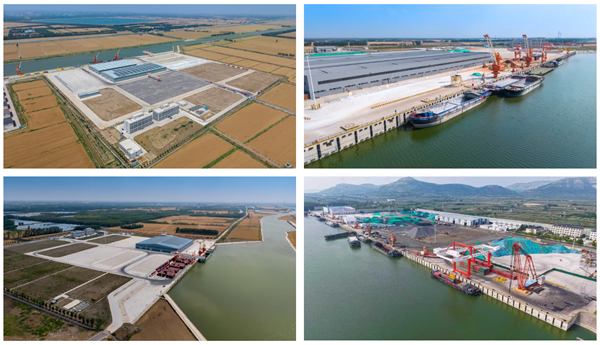
A bird's-eye view of four river ports of Shandong Marine Group Ltd.
Record High Throughput
Dongping Port grew its container business by leveraging the logistics channel connecting the Beijing-Hangzhou Grand Canal and Xiaoqing River in Shandong Province. The port’s container throughput in the first quarter reached 5,147 twenty-foot equivalent units (TEUs).
Zhangqiu Port has introduced a coordinated operating model to handle complex working scenarios, enabling the simultaneous handling of large-sized and bulk commodities. On March 14, its single-day throughput hit 11,490 metric tons, surpassing the 10,000-ton mark for the first time.
Gaoqing Port implemented a highly efficient loading and unloading mechanism, which allowed it to handle 5,057 TEUs of throughput in the first quarter, a 121-percent increase year on year and a record high.
Boxing Port was integrated into the local industrial chain and enhanced coordination with the upstream and downstream enterprises, achieving efficient cargo distribution and transportation. From Feb 24 to 26, its daily throughput surpassed 10,000 tons for three consecutive days, even reaching a record high of 13,900 tons in one day.
Diverse Cargo, Extended Routes
Tengzhou Port introduced new cargo types, including dolomite and clay. It can send commodities to places as far as Southwest China’s Chongqing Municipality, expanding its logistics reach.
Dongping Port packed bulk commodities, such as anode carbon block, starch and urea, into containers and launched direct routes to the cities of Xuzhou, Taicang and Nantong in East China’s Jiangsu Province, establishing an inland waterway logistics network that connects eastern, central and coastal regions of China.
Jinan Port facilitated the trade of calcined petroleum coke by cooperating with local factories, opening a new inland waterway logistics corridor from central Shandong to the upper reaches of the Yangtze River.
Zhangqiu Port efficiently loaded out-of-gauge cargo for shipment to South China’s Guangdong Province and Guangxi Zhuang Autonomous Region, as it excelled in large commodity logistics. In this way, it offered a green, convenient and comprehensive logistics solution for regional equipment manufacturers.
Gaoqing Port diversified the cargo structure while continuing to handle the existing cargo sources, such as calcite. It developed 14 new cargo categories for its container business, including finished paper, base oil and alumina.
Smart Port, Innovative Development
Yizhou Port and Dongping Port conducted trial operations of a smart port and shipping logistics platform, facilitating data connectivity between the Beijing-Hangzhou Grand Canal and Xiaoqing River waterways and better enhancing the coordinated efficiency of the two river systems.
Zhangqiu Port and Gaoqing Port put an artificial-intelligence-assisted gate into operation, enabling automatic container number recognition, license plate identification, and real-time integration with weighbridge data. In this way, container trucks could be identified in an instant and smoothly pass the gate. The average gate transit time for a truck was reduced to 10 to 15 seconds, increasing efficiency by over 60 percent and reducing manual costs by over 50 percent.
Boxing Port independently developed a dual-ear steel coil specialized lifting spreader, integrating electric drive with mechanical operation. The machine pushes hourly handling capacity beyond 650 tons.
In the future, SDMG will focus on diversifying cargo, enhancing efficiency and optimizing services, and will leverage the advantages of the Beijing-Hangzhou Grand Canal and Xiaoqing River to provide better shipping and logistics services, contributing to the drive of building Shandong into a demonstration zone for strong transport capacity.
(Executive editor: Zuo Shihan)