The Simandou project, an integrated mining and infrastructure mega-project in Guinea, has an annual shipping capacity of up to 120 million tons, accounting for approximately 5 percent of the total global iron ore trade demand. Its commissioning marks not only a major milestone in Guinea's industrialization process, but also serves as a vivid testament to Asia-Africa cooperation and mutual benefit.
China Harbour Engineering Company Ltd. (CHEC), a subsidiary of China Communications Construction Company Ltd. (CCCC), has been deeply involved in the planning and implementation of key port projects for the Simandou project. It is primarily responsible for the ore terminal and approach channel construction, as well as the basin dredging works the Morébaya Port — a supporting facility for the Winning Consortium Simandou (WCS) project.
In July 2025, the ore terminal project at the Morébaya Port, undertaken by CHEC, was finished and handed over to the owner for operation. This project is the first completed core supporting facility for the Simandou project.
As a crucial link in Guinea’s mining-driven value chain, the Morébaya Port will fully unlock the transportation corridor for the Simandou project. It is projected to catalyze resource development worth tens of billions of US dollars along the railway and around the port, helping double Guinea’s GDP while injecting a powerful impetus into local social and economic growth.
During the project´s construction, CHEC employed Chinese standards, designs, construction techniques, and equipment, cooperated closely with Chinese and foreign partners, and delivered high quality work. With the completion of the port, the first shipment of iron ore has been sent out to the global steel market.
Chinese Standards Set New Benchmark for African Ports
The ore terminal project of the Morébaya Port, a supporting facility for the Simandou project, is one of Guinea’s first high-pile wharves constructed in accordance with Chinese standards. The project involves four new 12,000-DWT berths and approach bridges, with an ore transfer station positioned between the two northern and the two southern berths.
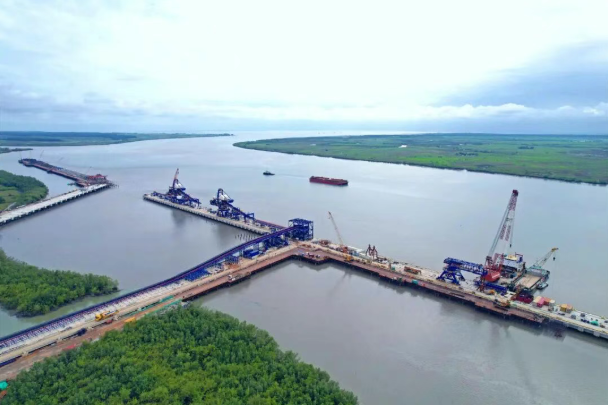
The ore terminal project of the Morébaya Port, a supporting facility for the Simandou project, is one of Guinea’s first high-pile wharves constructed in accordance with Chinese standards. [Photo/sasac.gov.cn]
The ore terminal project of the Morébaya Port is a landmark project for deepening China-Guinea cooperation and jointly building the Belt and Road Initiative. However, its construction faced multiple challenges, including complex geological conditions, a harsh climate and social instability. To successfully adapt China's highly developed port construction technical standards to Africa, the project team had to overcome various difficulties, rely on Chinese technological prowess and engineering expertise, and break through technical bottlenecks.
Chinese Supply Chain Breaks Through Material Bottlenecks
Due to prolonged underdevelopment, Guinea relies heavily on imported construction materials, yet neighboring countries can not meet the project’s demand for high-standard supplies. Materials commonly available in China, such as steel casings, high-strength rebar, special cement and rubber fenders, became critical bottlenecks constraining progress in Guinea.
Together with the WCS, the project team launched a trans-continental supply chain initiative, planning to complete procurement in China and ship all key materials to Guinea within four to five months.
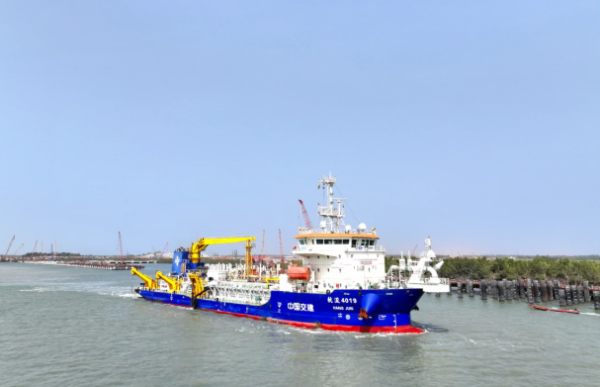
The project team launched a trans-continental supply chain initiative, planning to complete procurement in China and ship all key materials to Guinea within four to five months. [Photo/sasac.gov.cn]
Subsequently, tens of thousands of tons of supplies were shipped from China´s Yantai Port on dozens of ocean-going cargo vessels, which were organized by the project team. The convoy traversed the Strait of Malacca into the Indian Ocean, rounded the Cape of Good Hope and sailed north along the West African coast before finally arriving at the Morébaya Port in Guinea.
In June 2025, with the arrival of the final ship, this steel lifeline stretching from the shores of the Yellow Sea to the coast of West Africa had created an engineering marvel. Tens of thousands of tons of Chinese-made construction materials traveled 10,000 kilometers and arrived in Guinea on schedule, ensuring smooth construction of the Simandou project.
Chinese Expertise Offers Ingenious Solutions
Guinea's annual rainy season can last for up to half a year, with rainfall being frequent and unpredictable. The construction site features complex stratigraphy—including marine sedimentary layers, loose sand strata, and hard continental pluvial granite—making borehole walls prone to collapse during drilling. These circumstances posed great challenges for the project team, testing their ingenuity.
To keep the project on schedule and maintain quality, the team had to capitalize on brief rain‑free periods for efficient construction. This led to the launch of the "90‑Day Management Enhancement Plan". The project fully implemented lean management by optimizing staffing, strengthening key positions and establishing a dedicated liaison mechanism. This ensured timely information flow and smooth coordination.
The key to efficient work during dry intervals was reducing the construction time required for each pile. After repeated discussions and calculations, the time was shortened from 45–60 minutes to 30–36 minutes.
To prevent collapse during drilling, the project team proposed a solution. First, they drove steel casings — 28 meters in average length and 12–15 millimeters in thickness — into the stratum to reinforce the borehole. Whenever the drill bit showed anomalies at the soil‑rock interface, the team immediately conducted overnight analysis of rock cuttings. By discerning changes in the sound produced when the bit struck the granite, they accurately determined the properties of the rock layers and adjusted equipment parameters in a timely manner.
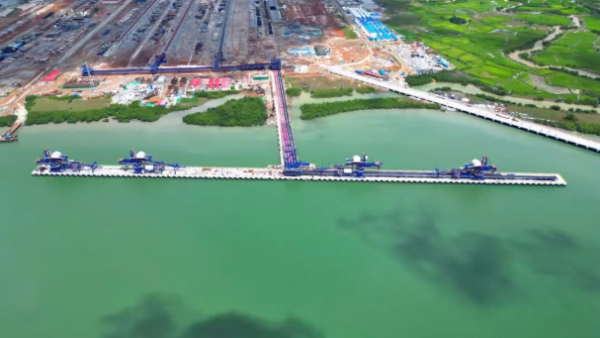
A bird’s eye view of the construction site of the port. [Photo/sasac.gov.cn]
In the dredging work at the wharf front, the project team faced even sterner challenges. In response, they carried out technical optimizations and developed a precise forecasting system based on tide predictions to arrange operation periods accordingly. Combined with real-time hydrological monitoring data, the system allowed for optimized construction sequencing. Meanwhile, the trailing suction hopper dredger team developed dynamic positioning and track-control technology. Through a multi-vessel coordination mode, high construction accuracy was successfully kept, completing the dredging tasks in high-risk areas.
The Morébaya Port terminal was completed in 18 months, two months ahead of the contract schedule. As the first key project completed in the Simandou region, it has laid a solid foundation for Guinea’s infrastructure development. Rising from a barren shore into a transportation hub, the port demonstrates the capabilities of CHEC, carries Guinea’s aspirations for development and stands as a new symbol of China-Africa friendship.
(Executive editor: Zuo Shihan)