Using advanced construction technology from China, a dual-girder, self-balancing launching gantry placed a precast T-beam into position on the Mfuti Bridge in Kinshasa, the capital city of Democratic Republic of the Congo (DR Congo), on March 29.
It was the first time that this kind of machine was used to build infrastructure in DR Congo, filling the country’s technical gap in bridge construction. It also signals the official start of superstructure works on the Mfuti Bridge, effectively fast-tracking the development of Kinshasa’s key transport corridor.
“The launching gantry can precisely and effectively install beams. The dual-girder structure helps it maintain balance, thereby reducing the pressure on the bridge surface,” said a project head of China Railway Resources Group Co., Ltd, the project’s general contractor. “The whole installation is in compliance with norms and highly efficient, both ensuring construction safety and accelerating the building process.”
The construction team is making every effort to build the bridge’s key parts in an organized way to ensure that they can complete the task on schedule.
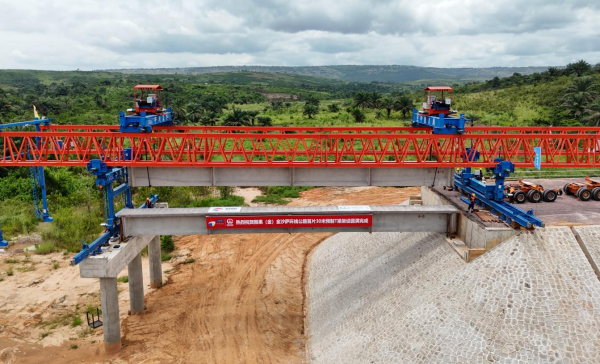
The Mfuti Bridge construction site of the Kinshasa ring road project in the Democratic Republic of the Congo. [Photo/sasac.gov.cn]
The 120-meter Mfuti Bridge is a crucial section of the Kinshasa ring road project. The launching gantry, with a rated capacity of 160 metric tons, is advanced equipment widely used in bridge construction in China.
“Compared with traditional machines, this one is more stable and more compatible with complicated construction scenarios,” said Liu Yufeng, head of the construction team of China Railway No 8 Engineering Group Co., Ltd. “It can precisely install beams, enhancing construction efficiency.”
The Kinshasa ring road is a crucial infrastructure project in the China-DR Congo cooperation package. The southeast and southwest sections of the road are 72.5 kilometers long in total. Since the construction began, the project has provided more than 5,000 jobs and training on construction techniques for local people. It has become a good example of China-DR Congo cooperation.
(Executive editor: Zuo Shihan)