Jushi Group Huaian Co., Ltd., a subsidiary of China Jushi Co., Ltd., put into operation a production line on March 18 that has an annual capacity of 100,000 metric tons of electronic fiberglass and 390 million meters of electronic textiles in Huai’an City, East China’s Jiangsu Province.
As an important part of the world’s first zero-carbon, smart fiberglass production base, the production line ushers the base into a new developmental phase.
The production line will supply high-end electronic materials to emerging industries, such as consumer electronics, 5G communications and industrial control, consolidating the material foundation for China’s new-generation information infrastructure.
The supporting wind farm can generate about 1.24 billion kilowatt-hours of electricity annually, offsetting nearly 1 million tons of carbon emissions. The clean power it generates will be used in the full circle of fiberglass production, enabling the products to comply with carbon neutrality standards.
World’s Largest Production Line
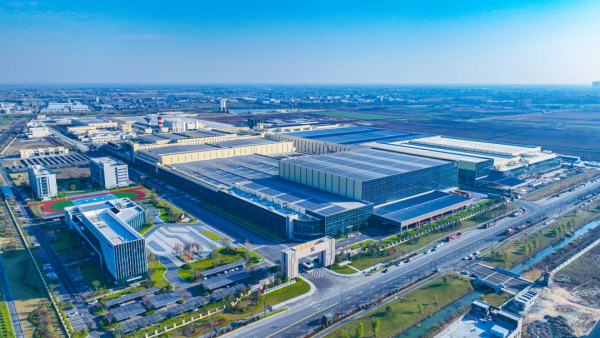
The production line can produce 10 percent of the world’s electronic textiles. [Photo/sasac.gov.cn]
The production line adopts a range of advanced technologies, to which Jushi Group Huaian Co., Ltd., has full intellectual property rights. Owing to the smart production processes backed by industrial internet, artificial-intelligence-assisted quality inspection and digital twin technology, its productivity is enhanced and energy consumption is reduced.
With the fast development of the emerging industries, such as AI, 6G and intelligent connected vehicles, electronic substrate materials are advancing toward ultra-fine, ultra-thin, and high-frequency performance. The production line can produce high-end electronic substrate materials such as ultra-fine yarn and ultra-thin fabric, thereby meeting the urgent demand for high-performance substrate materials in emerging industries.
Zero-Carbon Production Base
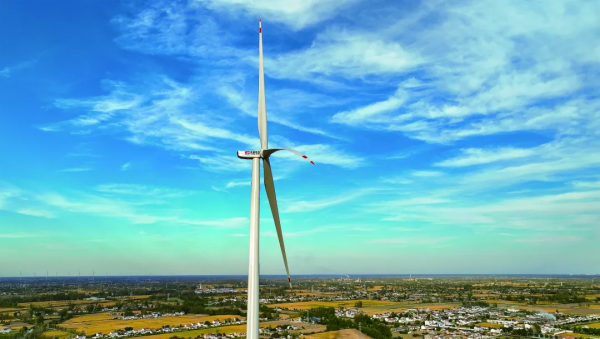
Turbines generate green power for the production base. [Photo/sasac.gov.cn]
The production base can reduce carbon emissions from the source of fiberglass production. It makes fiberglass with clean power and uses fiberglass to generate clean power, thereby forming a micro industrial cycle.
A group of white turbines that are more than 180 meters tall, each with its blades made of fiberglass, churn out clean electricity for the production base. They are part of the wind power project established to support the production base. The first phase with 233-megawatt capacity has been connected to the grid, with 47 turbines generating over 600 million kWh of electricity annually and reducing over 400,000 tons of carbon emissions. The second phase, with a capacity of 500 megawatts, is expected to generate 1.24 billion kWh of electricity annually once operational, reducing 1 million tons of carbon emissions, equivalent to the carbon absorption of nearly 9 million trees. In this way, a circle is achieved in which the base produces fiberglass and uses it on turbines, and the turbines generate clean power for fiberglass production.
Jushi Group Huaian Co., Ltd., also promotes the development of building-integrated photovoltaics and has equipped its wind farm with energy storage facilities. It has pioneered trials of furnace combustion that blends hydrogen with natural gas and established a clean energy supply system that integrates wind, solar and hydrogen power and electricity storage. The production base now solely consumes green power.
(Executive editor: Zuo Shihan)