The Aisheng Lingque Hongyun unmanned aerial vehicle (UAV) was delivered and made its first cross-valley flight on March 20 in Honghe County, Honghe Hani and Yi Autonomous Prefecture of Southwest China’s Yunnan Province.
The UAV was developed by Xi’an Aisheng Technology Group Co., Ltd., a subsidiary of China North Industries Group Corporation Limited (NORINCO Group).
This aircraft is specially designed to transport agricultural products and other materials in Honghe County’s mountainous areas. After being delivered, it completed the first cross-valley transport mission. It carried newly harvested agricultural products over a 15-kilometer-long, 1,200-meter-deep ravine and flew straight to the county’s distribution center, opening an air corridor above the mountains.
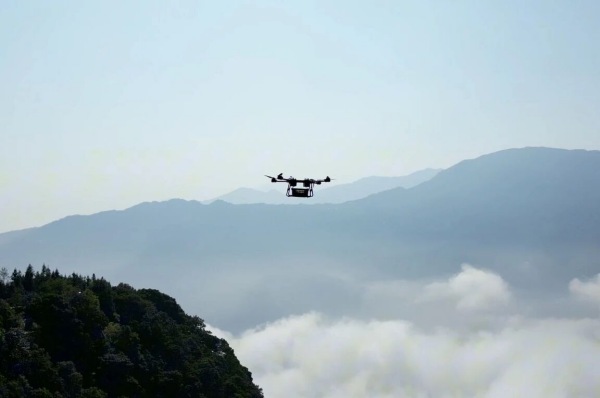
The Aisheng Lingque Hongyun unmanned aerial vehicle completes its first cross-valley transport. [Photo/sasac.gov.cn]
The UAV can stably transport a 40-kilogram payload amid moderate gales at an altitude of 2,000 meters. Its service can resolve transport difficulties in the mountainous areas, where loss and damage are common as agricultural products are transported along long, bumpy roads. The UAV can reduce manual costs by 30-40 percent and deliver high-value-added agricultural products, like mushrooms, to the market in a timely manner to meet customers’ needs for fresh foods.
Xi’an Aisheng Technology Group Co., Ltd. applies its independently developed Aisheng Tianyu comprehensive control system on the aircraft to ensure safe and controllable low-altitude transportation amid the mountains. The system, lauded as “an artificial intelligence advisor”, can perceive the conditions, transmit data, make calculations and control the aircraft. Smart, integrated and coordinated, it plays an important role in urban low-altitude economy and public security.
The Aisheng Tianyu system employs digital twin modeling technology and multisource heterogeneous sensors to create a low-altitude panorama including the mountains, a preset route and the UAV’s location and speed, to achieve real-time control along complicated routes.
With the help of AI algorithms, it can identify the risks, such as the unreported UAVs, potential crashes, weather changes and route deviations caused by airspace congestion, and give corresponding warnings.
The system can also connect with police, civil aviation administration, governments and enterprises, enabling them to respond to the emergencies together. In this way, it will provide support for building a large-scale, regular low-altitude transport network in Yunnan’s southern mountainous areas in the future.
(Executive editor: Zuo Shihan)